

On 24 September we ran a client webinar with analystsVeyt on the subject of 'Ambition or Compromise: What the EU ETS review means for carbon markets and industry'.
In case you missed it, we've put together a series of blogs examining the key themes and insights that emerged.
In this blog, we're looking at one of the hottest topics in the ongoing negotiations: free allocation to industry.
For our first insight article from the live session click below:
Deal maker or Dealbreaker? What an 8-month deadline means for ETS negotiations.
Industrial competitiveness attracting air time
As the EUA price rises back towards €90, the perennial question rears its head again – can the ETS deliver decarbonisation without driving deindustrialisation?
The current ETS review comes at a moment of great pressure for EU industry: energy crisis, competition from China, CBAM yet to ramp in.
Some see carbon costs as an unnecessary addition – with the Italians and Czechs once again leading calls for ETS suspension.
And as the ETS review progresses, the issues which are most directly felt by industry are attracting the most attention.
Chief among these: free allocation.
A complex calculation
The number of EUAs handed out as free allocation depends on both ‘top-down’ and ‘bottom-up’ calculations.
For each individual installation, its free allocation volume is calculated using benchmarks and activity level.
But there is also an overall limit to the number of free allowances that can be handed out.
This is approximately 46% of the cap: 43% as standard plus a 3% flexibility buffer.
If the sum of all the ‘bottom up’ calculations goes above this, the Cross Sectoral Correction Factor (CSCF) is applied equally to each installation to bring the total back down to the limit.
This check is done once per 5-year period. The CSCF was not applied for the 2021-25 or 2026-30 periods.
The actual allocation received is then adjusted to reflect sectoral exposure to carbon leakage.
Under current rules:
Non-leakage sectors
Free allocation phased out – in 2026 installations received approximately 30% of benchmark-based allocation, falling to 0% by 2030.
CBAM sector
A slower phase out - in 2026 installations received 97.5% of benchmark-based allocation, falling to 0% by 2034.
Benchmarks
The fallback benchmarks for heat and fuel are currently being progressed in a parallel, accelerated file to the main ETS package.
CBAM phase-out
Proposed to be delayed from original trajectory, delaying total phase out to 2038.
Conditionality
The Commission proposed to award 80% of free allocation following submission of an authority-approved decarbonisation plan, and 20% on verification of implementation of this plan.
Linear reduction factor
Determines the annual cap and therefore the point at which the CSCF bites.
New fallback benchmarks
About 80m extra allowances for 2026–30, applied retroactively through a separate fast-track file. The Council and Parliament amendments may add another ~30m through these benchmark changes.
CBAM phase-out slowdown
Adds about 27m over 2028-30.
Negotiations focus
The challenge of free allocation being such a focus of negotiations is that so many policy issues touch on free allocation volumes:
All of these issues have attracted attention in the ongoing ETS Review negotiations, but none more so than the question of conditionality. It has been an extremely controversial topic, high on the agenda of both Parliament and Council.
Concessions
The Commission proposal has been reported as giving the industry an additional ~106 million allowances in free allocation before 2030. This is made up of:
After 2030, the free allocation buffer share rises from 3% to 4%, freeing another 50–60m over 2031–40.
The free allocation illusion
Focus on conditionality and the concessions has resulted in a big issue going under the radar: the impact of the CSCF.
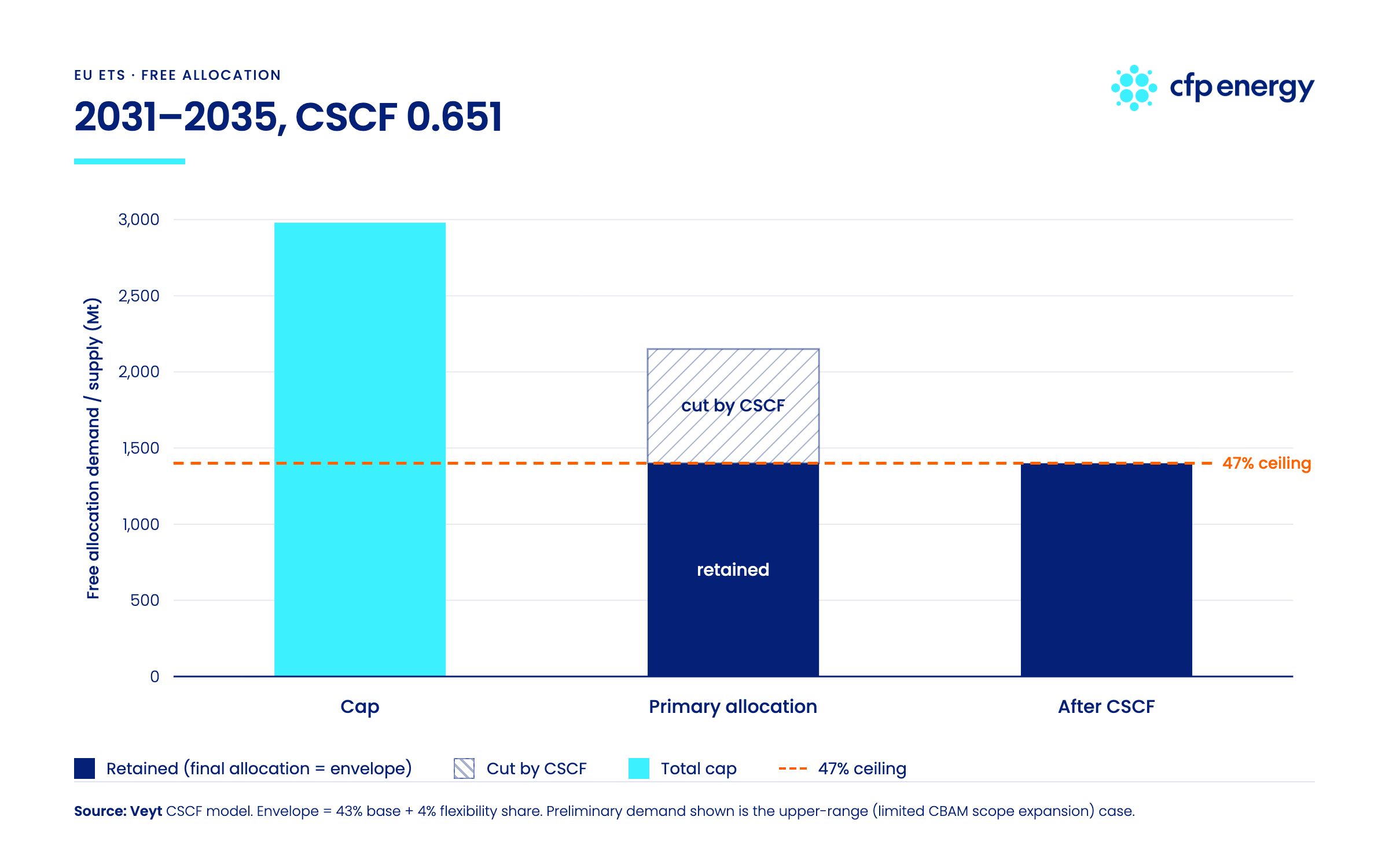
Post-2030, the ambitious LRF of the late 2020s starts to bite, and the cap limits free allocation more than benchmarks do.
For 2031-35, Veyt modelling under the Commission proposal indicates a CSCF of about 0.65, meaning it cuts 35% of free allocation across the board.
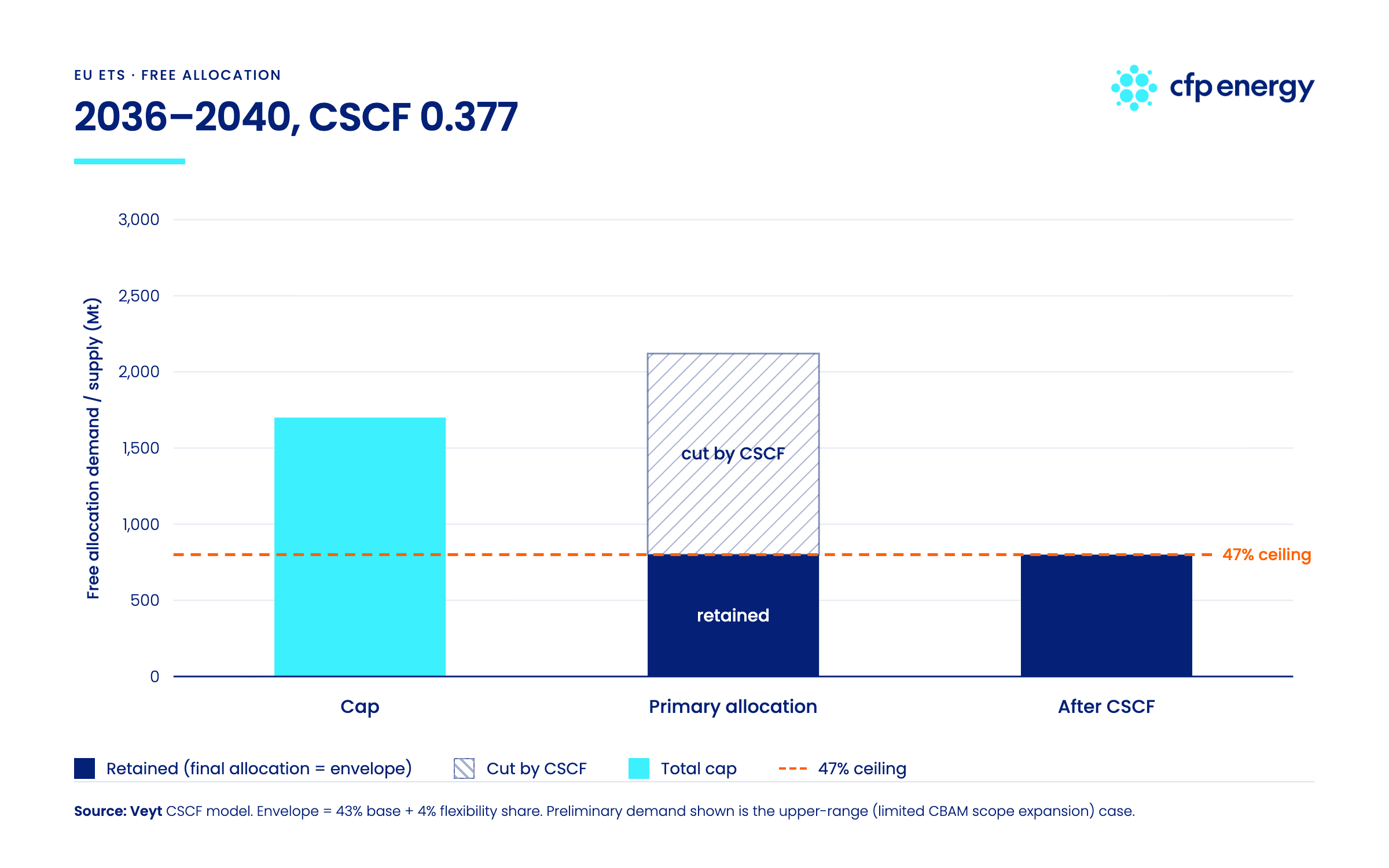
By 2036-40 the CSCF shrinks even more to 0.38, cutting over 60% of free allocation.
Supply constraints are the main driver, not benchmarks or CBAM.
The takeaway for compliance buyers
Operators should be preparing for a significant reduction in free allocation after 2030.
The negotiations will determine the scale of that reduction, but Veyt’s modelling shows substantial cuts even under the Commission’s proposed concessions.
Lower allocation means more allowances to buy unless emissions fall sufficiently. For operators assessing their future exposure, assumptions about free allocation deserve as much attention as the carbon price.
That means looking beyond individual announcements on benchmarks or CBAM and assessing what the full calculation leaves an installation with.
CFP Energy helps operators understand policy changes and develop strategies to manage their carbon compliance requirements.
To discuss what falling free allocation could mean for your business, contact our team.

About the author: Polly Thompson
Polly Thompson is the Carbon Policy Lead at CFP Energy, focusing on policy and market analysis across compliance and voluntary carbon markets. She tracks regulatory developments and market trends, helping organisations navigate an evolving carbon landscape.
Related Articles



Share this article


