
.jpg?width=1920&name=luka-slapnicar-yqeXLR81Uj0-unsplash%20(1).jpg)
CORSIA in focus
The European Commission has proposed that from 2029 the EU ETS will expand to cover a limited proportion of extra-EU flights: those leaving the EU for destinations less than 5,000 km from the EU.
The ETS will be a ‘top up’ to CORSIA, not a replacement.
CORSIA will be reassessed in 2032. If deemed sufficiently ambitious, this change will be rolled back.
In a separate legislative proposal, the Commission is exploring introducing additional criteria for CORSIA Eligible Emission Units (CEEUs) used by EU airlines.
The latest developments suggest any criteria will apply to Phase 2 only, with Phase 1 criteria removed as a gesture of support. A vote is due in autumn...
These proposals will be negotiated with the Parliament and Council and are likely to be amended.
ETS context
On 17th July the European Commission published a proposal for a package of reforms to the EU ETS.
The impacts stretch beyond the ETS, especially for the aviation sector, where the EU’s position on CORSIA has been watched with interest.
Two aviation-related questions dominated speculation in the run up to the proposals:
Will the EU ETS will expand to cover extra-EU aviation?
Will the EU will impose additional criteria on emissions units used for CORSIA compliance?
We now have some clarity, with an important caveat: this proposal is just the start of the EU’s legislative process, and does not represent the final rules to be implemented.
The proposal will now be negotiated by the Council and European Parliament before a final text is agreed (earliest Q1 2027).
Aviation is a particularly contentious topic and so the proposals are expected to be significantly amended.

Expansion of the EU ETS to extra-EU aviation
Since 2012, ‘stop-the-clock’ legislation has deferred expansion of the EU ETS to flights to/ from non-EU destinations (extra-EU flights), in favour of the Carbon Offsetting and Reduction Scheme for International Aviation (CORSIA).
Stop-the-clock was due to expire at the end of 2026, unless criteria demonstrating that CORSIA is sufficiently ambitious and robust were met. These criteria were not expected to be met, obliging the Commission to recommend expansion of the ETS.
The Commission’s proposal was actually more nuanced: stop-the-clock is extended, except for departing flights for extra-EU destinations less than 5,000 km from the geographical centre of the EU.
This excludes destinations such as the US and China, but covers transport hubs such as Dubai, Qatar and Istanbul.
For such flights, ETS will apply from 2029 and importantly, does not replace CORSIA but acts as a ‘top up’, to avoid aviation companies being double-charged.
ETS obligations will be reduced to reflect the cost of CORSIA compliance.
In 2032 the Commission will again assess the ambition, efficiency and success of CORSIA.
If it is found to be sufficient against these criteria, this expansion to the ETS coverage can be reversed.

Additional EEU eligibility criteria
It is now clear that any introduction of additional criteria for CORSIA Eligible Emissions Units (EEUs) for EU airlines will be a separate legislative procedure.
In a Climate Change Committee meeting on 15 June, the Commission proposed dropping any additional criteria for Phase 1.
This is pitched as: ‘a confirmation of the EU’s support of CORSIA and gives it another opportunity for strengthening its credit integrity’.
The Phase 2 criteria previously proposed remain, with PACM (Article 6.4 of the Paris Agreement) as the benchmark for eligibility.
The Climate Change Committee confirmed its ‘view to securing a positive vote on the draft act in the autumn.’
Like with the ETS proposal, this would then be followed by negotiations.
What happens next?
This remains the Commission's opening position.
The European Parliament and Council will now negotiate the proposals, with aviation likely to be one of the more politically contested parts of the package. The timeline is expected to be...
Commission proposal — published 17th July
Council position — agreed target of 11 December 2026
European Parliament position — rapporteur Peter Liese is targeting December 2026
Trilogue negotiations — Parliament, Council and Commission negotiate a final text.
Final agreement — agreed target for compromise agreement by the end of Q1 2027
Implementation — expected to be staggered over 2027-8
Expected negotiation outcome
We expected any expansion of ETS coverage regarding aviation to be blocked by the Parliament and Council. This softer proposal increases the likelihood of it surviving trilogue negotiations, but on balance it is still more likely than not to be voted down.
The future for the CORSIA EEUs Phase 2 criteria is less clear. It is likely to be lower profile and less politically contentious.
Why this matters...
There was widespread concern that the expansion of the ETS would supersede CORSIA, removing 24% of demand over Phase 1 and gutting the scheme.
Whether or not this proposal passes, the confirmation that any ETS coverage would be as a ‘top up’ to CORSIA rather than a replacement means that risk is removed.
Meanwhile the additional criteria initially pitched for Phase 1 would have made over 90% of pipeline supply ineligible for EU airlines.
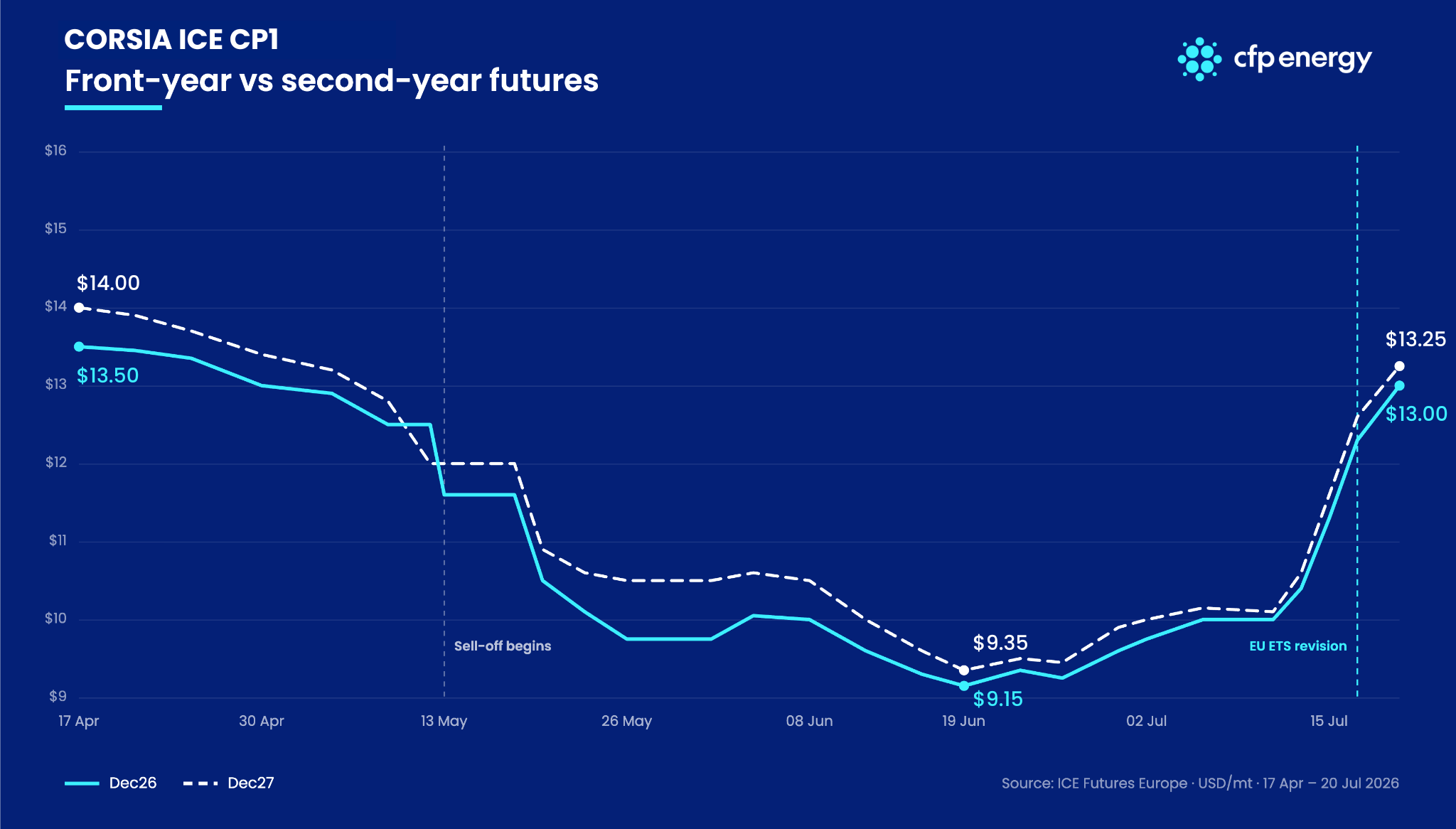
Since the proposal this has resulted in market bifurcation and sliding prices: Dec26 and Dec27 hit three-month lows of $9.15 and $9.35 in late June.
The Commission’s confirmation that there will be no additional Phase 1 criteria and removal of the downside risk of EU withdrawal from Phase saw both contracts adding roughly $1.50 in a single session.
Prices have continued to climb, settling at $13.00 and $13.25 on 20 July, a 42% move off the lows in under four weeks.
Open interest on ICE CP1 futures surpassed 1 million lots for the first time over the same period, suggesting the rally is being driven by genuine demand rather than short covering.
Support for the market
The EU has clearly signalled its support for CORSIA.
With Phase 1's compliance deadline approaching and the regulatory overhang now lifted, the constraint that matters is supply.
Eligible units remain scarce against the demand still to come, and the recent price recovery reflects that as much as improved sentiment.
The uncertainty that gave airlines a reason to wait has largely been removed.
The question for the market is no longer whether to engage, but at what price the remaining supply clears.
CORSIA and EU ETS experts from CFP Energy can be contacted for immediate support, here.
About the author: Polly Thompson
Polly Thompson is the Carbon Policy Lead at CFP Energy, focusing on policy and market analysis across compliance and voluntary carbon markets. She tracks regulatory developments and market trends, helping organisations navigate an evolving carbon landscape.
Related Articles



Share this article