
path-to-bankability-lead-magnet
This white paper from CFP Energy and Ara Partners draws on the Vaulted Deep transaction to show how carbon removal projects can secure mainstream bank finance.

Carbon removal is moving from proving its technology to financing its growth.

That shift brings challenges and opportunities for developers, buyers and investors across the voluntary carbon market.

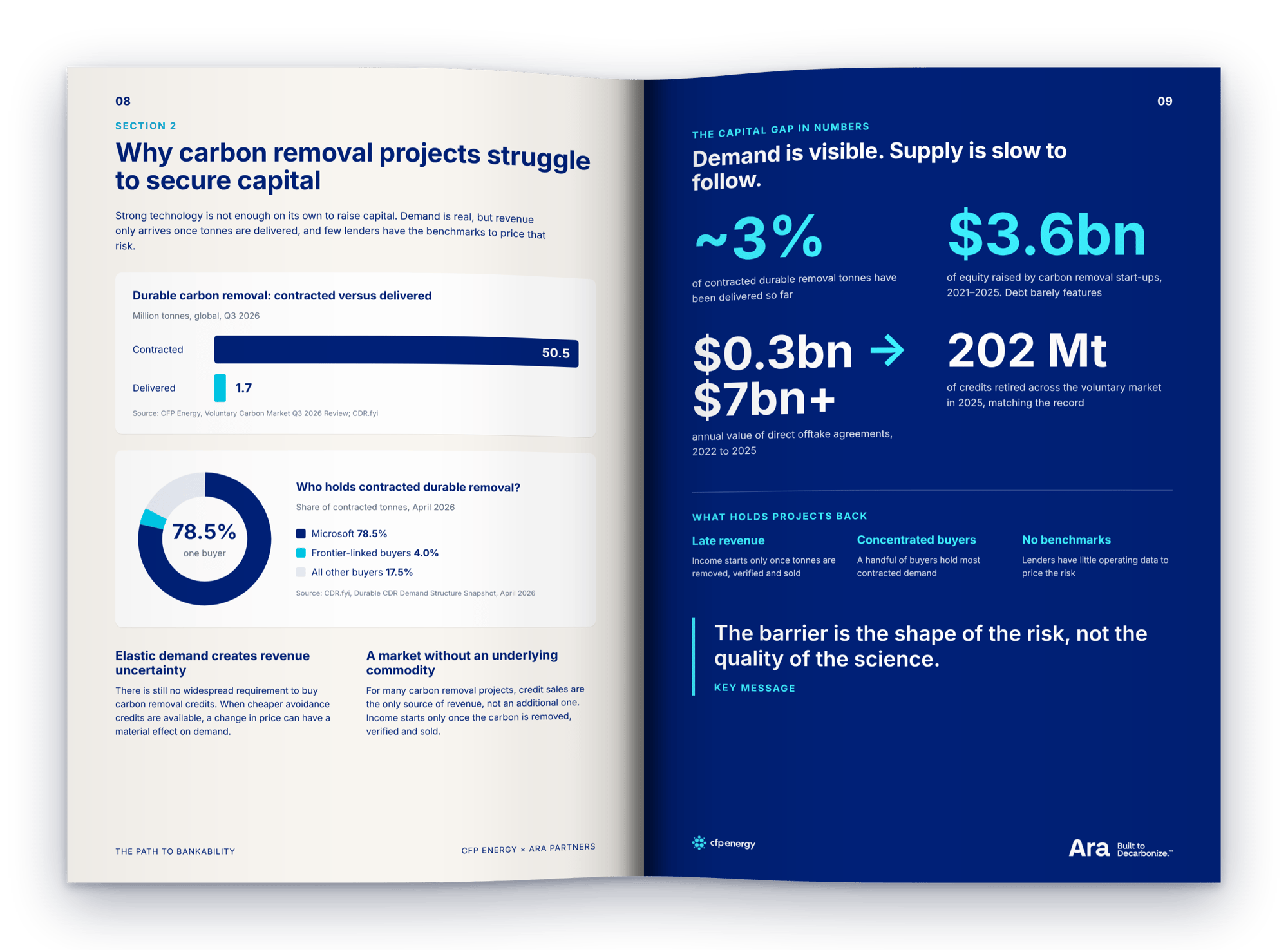
Around 50.5 million tonnes of durable carbon removal have been contracted worldwide, but only 1.7 million tonnes have been delivered. The gap is not a lack of demand. Developers can’t build fast enough on grants and equity alone.

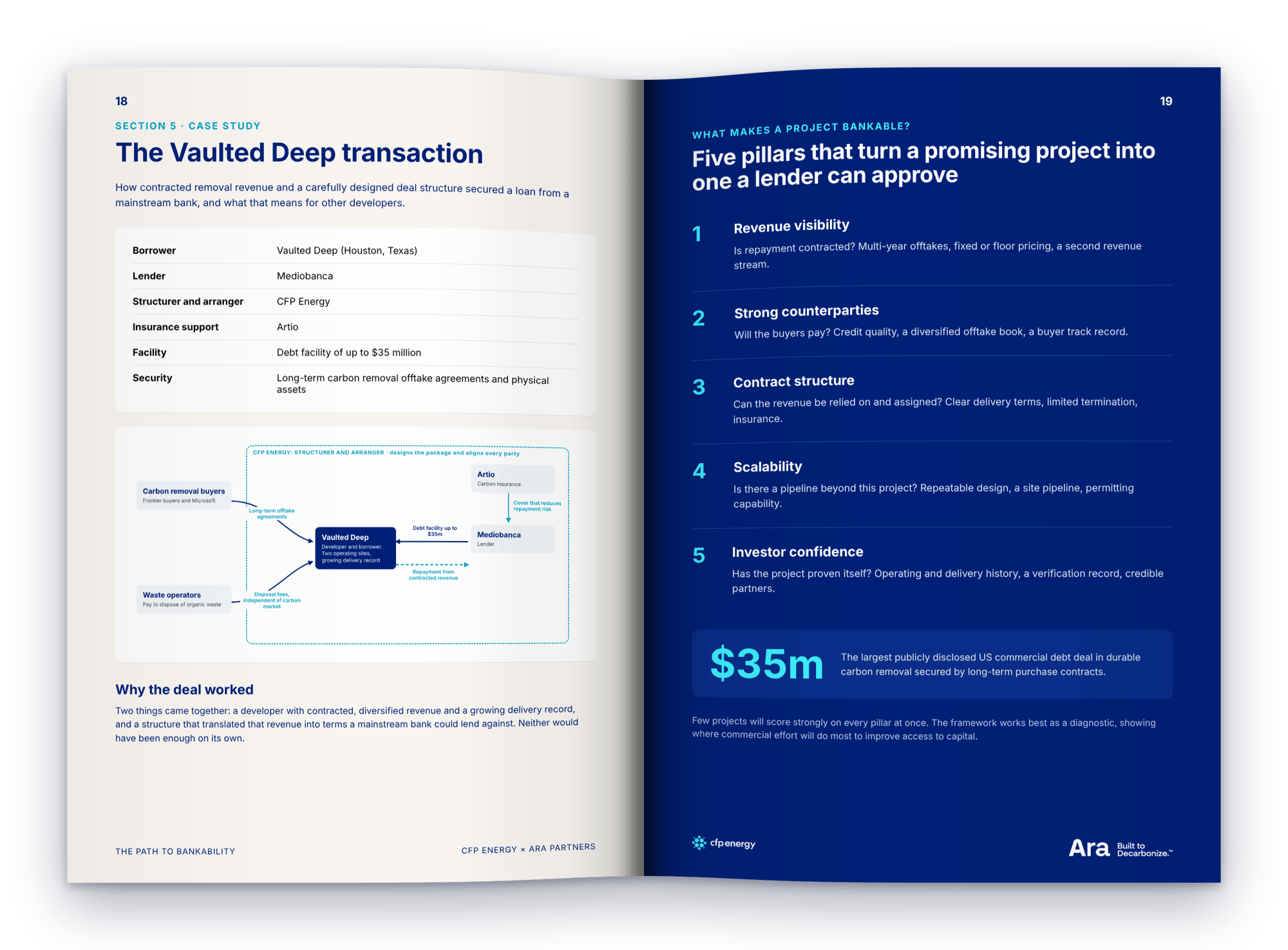
Using the US$35 million debt facility CFP Energy arranged for Vaulted Deep with Mediobanca as a case study, the paper sets out how long-term offtake agreements, insurance and careful deal structuring can turn future carbon revenue into something a bank will lend against.


Developers that design their projects with lenders in mind could reach cheaper, repeatable capital sooner, while those that leave it late risk stalling just as demand grows.

The paper also offers a practical framework of five pillars of bankability, and a blueprint for applying them across technologies, developer types and stages of growth. It shows how the market can move from one-off deals to infrastructure-scale finance.


Tyler Manchester

Head of Voluntary Carbon, CFP Energy

“We’ve been looking at carbon project investments as a firm for about 20 years, through different iterations of the market. What we realised was that the investments we were making didn’t necessarily match the stage of the market, or the stage of the project, in order to scale.

Projects that are operational, performing and already delivering need cheaper capital in order to scale and deliver into substantial offtake agreements.

We set out to create a financing product that would enable carbon projects to scale individually, while allowing new capital to flow into the market so the market as a whole can grow to the level it needs to be.”

12 (9)
110325-3.084 ret (2)-1

Jonathan Navon

Group CEO, CFP Energy

"When we founded CFP Energy, we set out to build a business that could make energy and environmental markets work more efficiently for the companies that depend on them.

Today, we provide solutions across carbon, power, gas, and biofuels. Each market has taught us the same lesson; the more finance and liquidity flow into the underlying products, the more creative the solutions that become available to end users.

The voluntary carbon market has now reached that point.

It began as a way for companies to offset what they could not yet reduce. It is now becoming a source of finance for the infrastructure that will remove carbon at scale.

Its biggest obstacles, from uncertain revenue to the gap between contracted and delivered tonnes, are commercial problems, which, as this report sets out, now have commercial solutions.

Finding these solutions take teamwork, perseverance and a bit of creativity.”

Spread 1 - mockup (transparent)

A comprehensive analysis of the voluntary carbon market


Demand for durable carbon removal has never been stronger, but only around 3% of contracted tonnes have been delivered. This paper sets out why, from how the voluntary carbon market has traditionally worked to the risks that keep lenders on the sidelines.

See where the capital gap sits, who is buying, and what developers need to show before a bank will lend.


And the solutions driving its evolution


Go inside the US$35 million Vaulted Deep debt facility and see how long-term offtake agreements, insurance and careful structuring turned future carbon revenue into something a mainstream bank would lend against.

Use our five pillars of bankability to test your own project, find where it is weakest, and see the steps that can open up cheaper, repeatable capital at every stage of growth.

  •  
Spread 2 - mockup (transparent)

Voluntary carbon market insights

Connect with our team