

On 12 November 2026, the UK government published its formal response to the Voluntary Carbon and Nature Markets: Raising Integrity consultation.
The document sets out how the government intends to put its six integrity principles into practice, covering credit quality benchmarks, buyer guidance, safe harbour protections, and the compliance pathways that will shape demand over the next decade.
This is a significant publication for anyone active in carbon markets.
The full response is available here.
Below is our reading of what it means in practice.
The integrity framework
The government has landed in the right place on quality.
The Integrity Council for the Voluntary Carbon Market's (ICVCM) Core Carbon Principles (CCP) and Assessment Framework, alongside the Paris Agreement Crediting Mechanism, are now the recognised benchmarks for identifying high-integrity carbon credits in a voluntary context.
The government explicitly chose not to create a separate UK claims standard, which avoids the fragmentation that many market participants were worried about.
Ratings agencies received a meaningful endorsement.
The response acknowledges that programme-level integrity standards do not assess individual project implementation, and encourages the use of independent credit ratings as a way for buyers to manage risks that methodology-level assessments alone do not capture.
For anyone who has spent time in the quality conversation over the past few years, this is a welcome and overdue recognition of where project-level diligence actually happens.
The government also confirmed that the UK's own Woodland Carbon Code has applied for ICVCM endorsement under the CCPs, with assessment currently underway.
This matters for domestic supply.
If the WCC achieves CCP alignment, it gives UK nature-based credits a clearer route to institutional and corporate buyers who are increasingly filtering by CCP eligibility.
The demand problem
Here the response gets honest, and the real tension in the market comes into view.
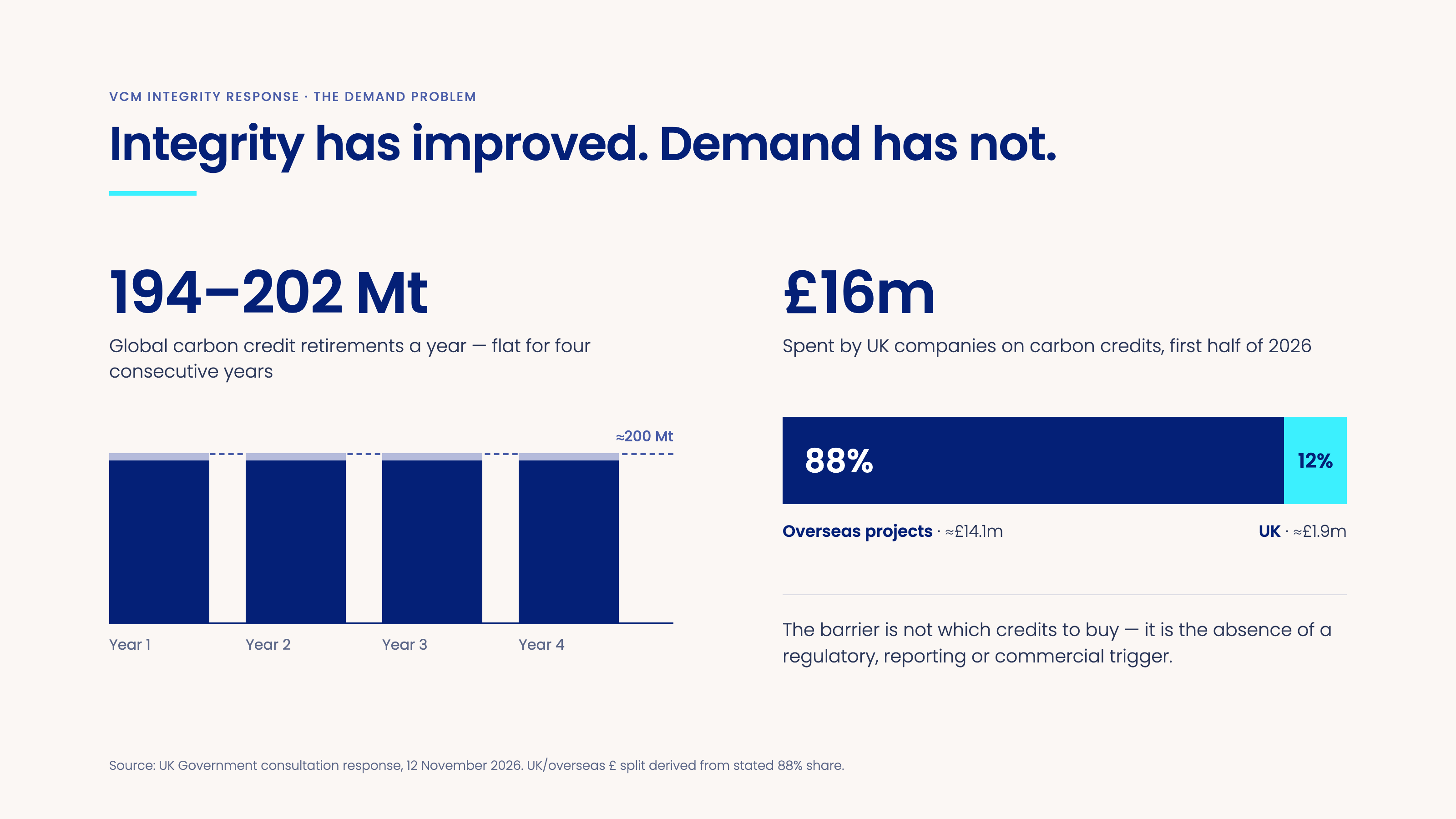
The government's own data tells the story clearly, global carbon credit retirements have been flat at between 194 and 202 million tonnes a year for four consecutive years.
UK companies spent approximately £16 million on credits in the first half of 2026, with 88% of that going to overseas projects.
Those are not numbers that suggest a market on the verge of scaling. And they do not reflect a lack of quality infrastructure.
The integrity tools are better than they have ever been.
CCP eligibility is becoming a baseline expectation in the RFQs we see. Buyers are asking more sophisticated questions about project quality, about ratings, about what sits behind a credit.
That shift is real and it has been driven by exactly the kind of standards and frameworks this response endorses.
The disconnect is that most corporates are still treating credit purchases as something they will get to, not something they are doing now.
The conversations we have with buyers are not held up by confusion about which credits to buy.
They are held up by the absence of a clear trigger, whether regulatory, reporting-linked, or commercial, that moves carbon from a sustainability team aspiration to a procurement line item.
Three use cases, and the one that matters most
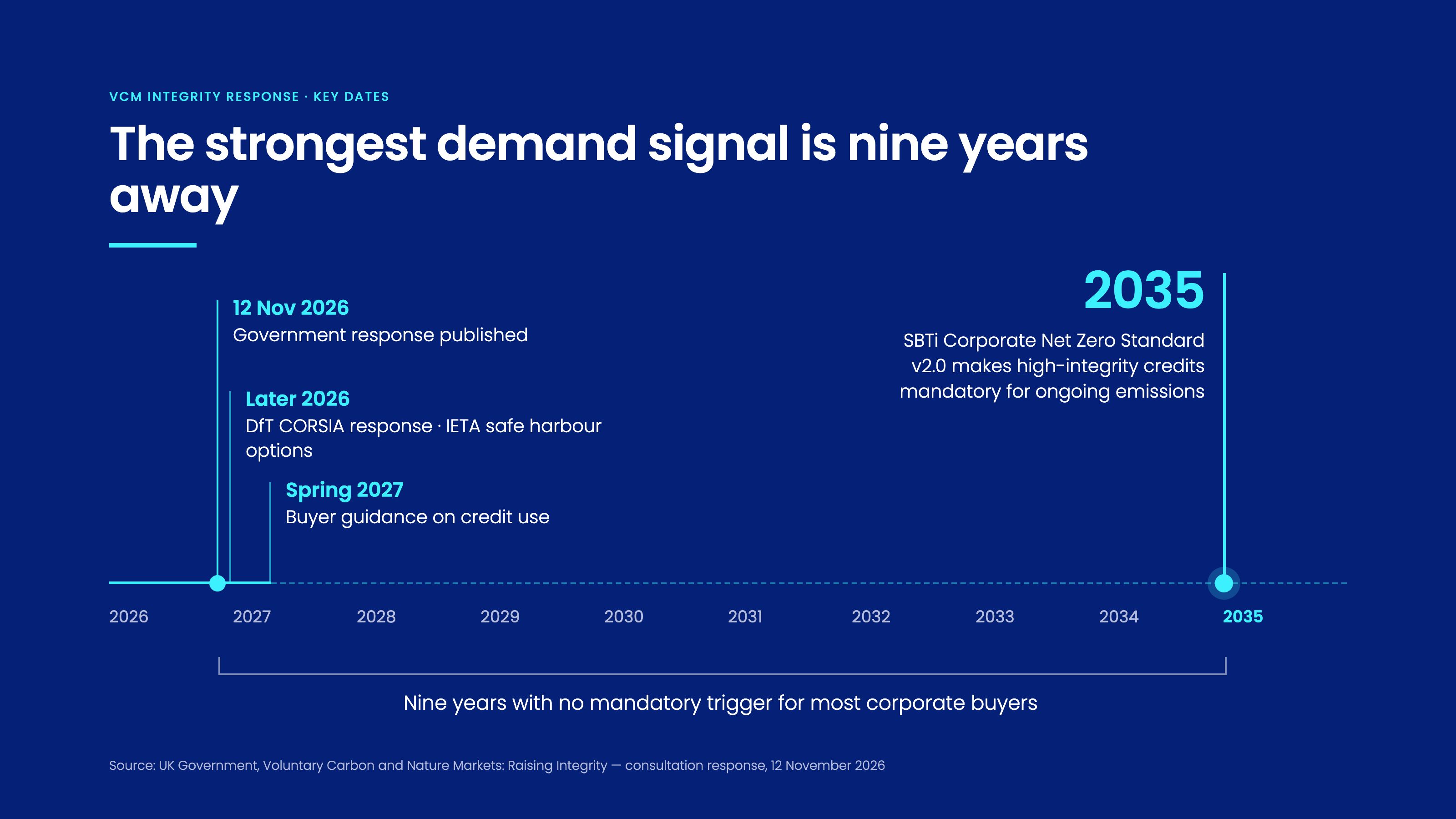
The government endorsed three use cases for the immediate business adoption of carbon credits: taking responsibility for ongoing emissions (aligned with SBTi's Corporate Net Zero Standard v2.0), counterbalancing residual emissions at organisational net zero using durable removal credits, and addressing historical emissions.
All three are sensible. The first is the one to watch.
SBTi's v2.0 standard introduces a mandatory role for high-integrity credits from 2035 under its "ongoing emissions responsibility" framework.
The government explicitly backs this use case and says it is working to encourage earlier adoption. We think the pace matters more than the principle here. 2035 is nine years away. That is a long time to wait for what is clearly the strongest demand signal the voluntary market has seen.
More importantly, every year of delay has a supply-side consequence. Project developers need forward commitments to build the pipeline of high-quality credits at the scale the market will eventually require. If demand remains deferred, the projects that would meet the 2035 standard do not get built in time.
The government is right to push for earlier adoption. The question is whether encouragement alone is enough, or whether reporting and procurement triggers need to come with it.
The historical emissions use case is newer and less developed, but worth watching. It opens a door for companies that want to go beyond their current footprint and take responsibility for cumulative past emissions.
Whether this translates into meaningful volume will depend on how it is framed in the spring 2027 guidance and whether corporates see reputational value in it.
Safe harbour: why soft measures will not be enough
The response draws a useful distinction between two forms of safe harbour protection.
Hard measures would mean statutory or regulatory immunity for organisations that meet defined conditions.
Soft measures would mean non-binding frameworks that might gain legal weight over time. The government is leaning towards starting with soft protections and building from there.
We understand the caution, but we think this underestimates the problem it is trying to solve.
The corporates we speak to are not dealing with abstract reputational anxiety. They are dealing with legal teams who advise against making specific claims about carbon credit use because the regulatory position is unclear.
A non-binding framework does not change the advice those legal teams give. It gives sustainability departments something to point to internally, which is helpful, but it does not remove the risk that sits between a buyer's intent and their procurement decision.
If the government wants safe harbour to actually move the needle before 2035, harder protections tied directly to the spring 2027 guidance would be significantly more effective.
A clear rule that says "if you follow this guidance, you are protected from greenwashing claims related to your credit use" would do more to unlock corporate demand than any other single measure in this document.
The government has commissioned IETA to elaborate on options through the Coalition to Grow Carbon Markets, and a response to those recommendations is expected soon.
That will be worth watching closely.
Compliance pathways and what is still missing
The compliance signals in this response are real and we welcome them.
CORSIA offsetting legislation is confirmed as imminent, with a separate DfT consultation response expected later this year.
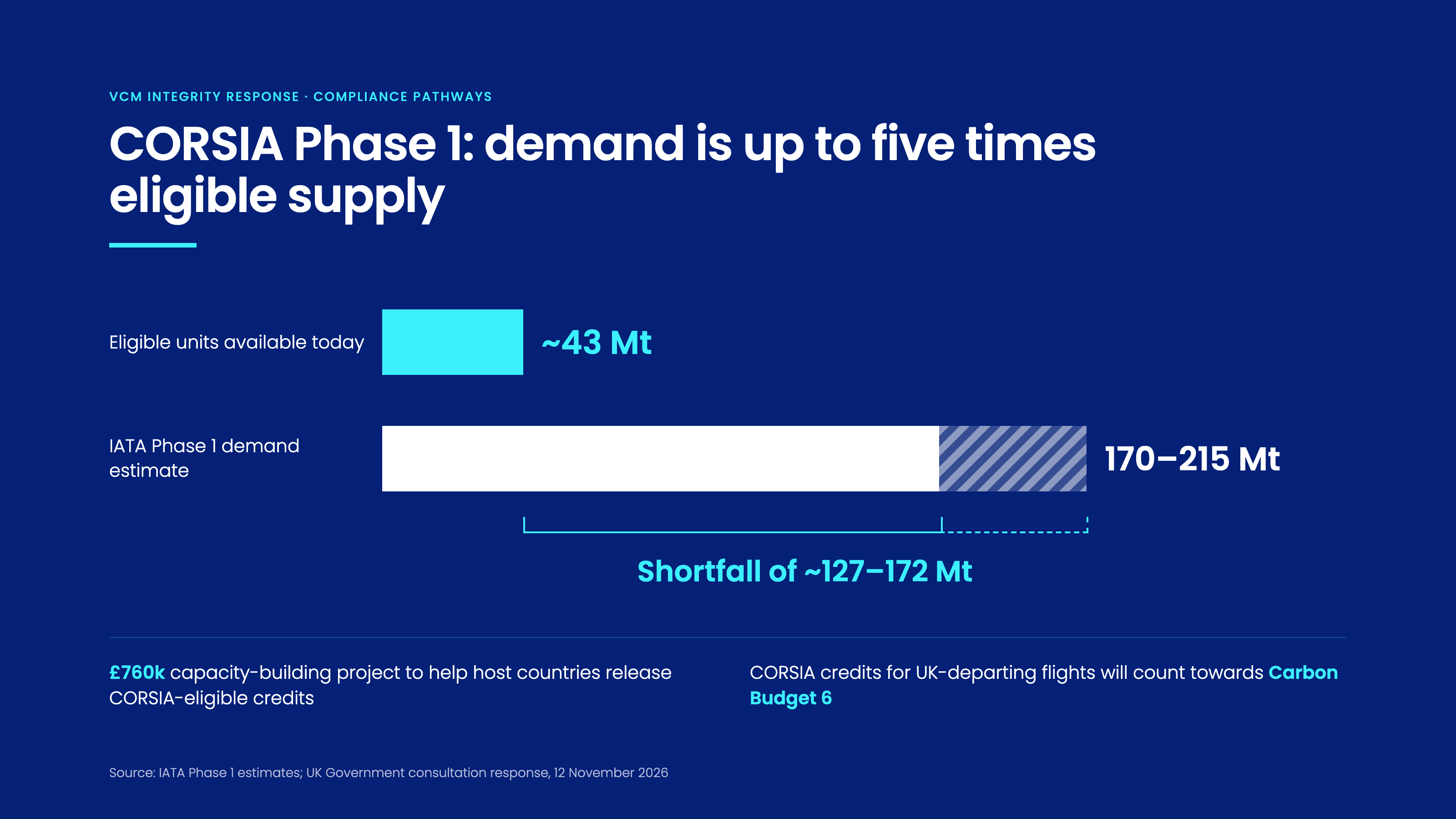
The government has also launched a £760,000 capacity building project to help developing countries meet the reporting requirements needed to release credits for airline use under CORSIA.
For context, IATA estimates Phase 1 demand at 170 to 215 million tonnes, while only around 43 million tagged eligible units are currently available. That supply gap is going to shape the CORSIA credit market for the next several years.
On the UK ETS side, the integration of engineered greenhouse gas removals will create a compliance-backed demand pathway for the developing removals sector.
A new GGR standard is being developed by BSI, aligned with the EU's Carbon Removal Certification Framework, the ICVCM, and the PACM.
This is a meaningful step for UK-based removal projects.
The government also confirmed that CORSIA credits purchased by UK airlines for UK-departing flights will count towards Carbon Budget 6.
That is a significant signal.
It turns airline compliance spend into something with national accounting value, which strengthens the investment case for CORSIA-eligible supply.
What is still missing is anything concrete for everyone outside aviation and the UK ETS.
The response acknowledges that stakeholders called for credit-use mandates, fiscal measures, and additional compliance-linked pathways. The government's position is that it "may consider them, where relevant, in due course."
That language has not moved since the consultation closed. It is the weakest part of an otherwise solid document.
The integrity architecture is now in place.
The compliance mechanisms for aviation and removals are being built.
For the rest of the voluntary carbon market, the investment case still rests on voluntary conviction and a 2035 SBTi deadline that most procurement teams have not started planning for.
Where this leaves the market
This is a good document.
The government has done the work on integrity, landed on the right benchmarks, avoided creating unnecessary UK-specific fragmentation, and confirmed the compliance pathways that will create real demand in aviation and removals.
The spring 2027 guidance, if it is practical and clearly linked to safe harbour protections, could move a meaningful number of corporates from intent to action.
The question that remains is whether the government wants voluntary carbon markets to be a niche for early movers or a mainstream tool for decarbonisation.
Right now, the answer to that sits somewhere in between. The direction is clear. The pace is not matching the ambition. The difference between a functioning market and a truly scaled one is not more guidance.
It is obligation, and the sooner the government is willing to say that clearly, the sooner the market can deliver on the potential this document describes.
About the author: CFP Energy
CFP Energy is a leading provider of energy transition services, working with large corporations across Europe and beyond. Our team provides access to renewable and transition fuels, carbon compliance services and long-term risk management solutions.
Related Articles



Share this article


