
2026 was a landmark year for Germany’s domestic carbon scheme, the nEHS, as it transitioned away from a fixed CO2 price and into a market-based approach.
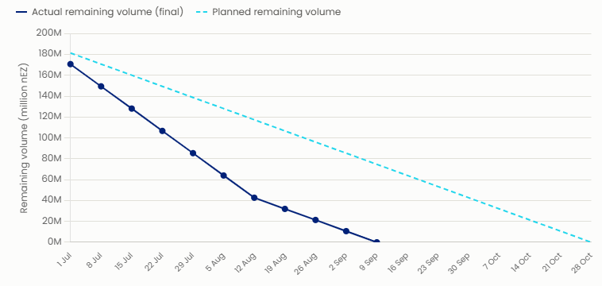
Eighteen weekly auctions were planned, running from 1 July to 28 October, with a price corridor of €55- €65.
But that wasn’t exactly how it played out. 11 auctions took place instead of 18, with last week’s final auction far before the planned 28 October finish, and every single auction clearing at €65, the top of the corridor.
Next year will see a new round of nEHS auctions, before the EU-wide ETS2 takes over in 2028. German policymakers have already reacted to this year’s auctions by adjusting the approach for 2027. Those changes also offer a preview of the pressures EU ETS2 will need to manage.
Recap: what is the nEHS?
nEHS is Germany's domestic carbon market for heating and road transport fuels. Companies placing these fuels on the market must surrender one national emission certificate, or nEZ, for every tonne of CO2e they're responsible for.
From 2021 to 2025, the nEZ price was fixed by the state, rising each year. This year a new approach was introduced: weekly auctions within a €55–€65 corridor. For more detail, have a read of our recent nEHS auction blog.
The auctions at a glance
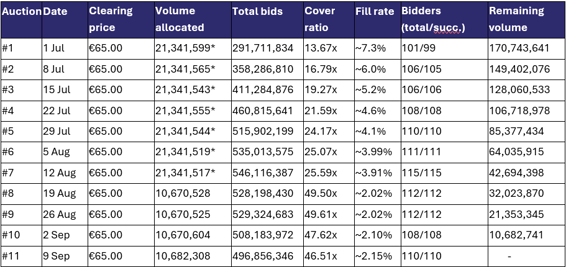
Every week cleared at the top of the price corridor, €65, despite policymakers’ intent to have a price corridor rather than a fixed price. By week three, this was clear to all participants and every bid from then on was at €65.
This dynamic isn’t totally surprising. Based on emissions from previous years, compliance demand is expected to exceed 250m nEZ, while the total allocated auction volume for 2026 is only 192m nEZ. With auctions the lowest-cost route to acquiring nEZ, they were always likely to be oversubscribed.
Why the calendar compressed: the €65 rule
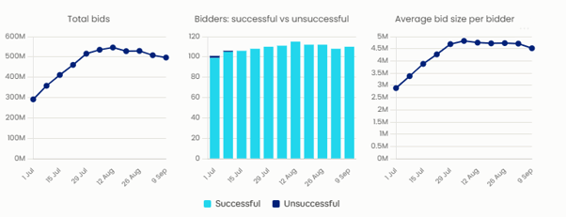
This oversubscription was what led to the accelerated auction calendar.
The auction schedule contains a simple rule: if an auction clears at €65, the allocated volume for that date doubles, drawing forward supply from later auction dates - as long as at least a third of the annual total remains. Auctions #1 to #7 all met that test, so each allocated 21.34 million nEZ rather than the planned 10.67 million.
With the total 2026 auction volume fixed at 192 million nEZ, every time the rule triggered the auction calendar got a week shorter.
What's next: post-auction sales and the secondary market
For companies still short of their obligations, two further formal routes remain, both are at a higher price point than the auctions.
- From November to December, unlimited quantities of 2026 nEZs are available at a fixed price of €68.
- A post-purchase window then runs until 31 August 2027 at €70, capped at 10% of a party's existing 2026 balance- intended only as a top-up option.
There's no exchange-based secondary market for nEZs. What exists is OTC trading through registered intermediaries. Given how oversubscribed this year's auctions were, this channel can expect more use than previous years.
The regulator's response: what changes for 2027
There has been some uncertainty regarding the nEHS going forward. EU ETS2 was due to start in 2027, replacing much of the nEHS. The EU’s decision to delay ETS2 means that nEHS will continue in full for another year.
On pricing, it was originally proposed that nEZ price would transition to being linked to ETS1 prices for 2027. However, the German Cabinet recently proposed a bill continuing the €55- €65 price corridor and auctions for 2027. The bill is still awaiting Bundestag approval, so is not yet law, but is expected to pass.
However, in response to this year’s auction dynamics, the bill does update some auction mechanics. The maximum bid per compliance account drops from 50% to 20% of that date's volume, and only compliance accounts (not speculative bidders) can participate directly. The government's own notes on the bill say this is designed specifically to counteract the oversubscription seen this year and to ease the liquidity strain of putting up security for large bids.
A few other changes point the same way. Certificates can't be carried across years: 2026 nEZ won't cover a 2027 obligation, and vice versa. The excess-sale and post-purchase prices both rise by €5 for 2027, to €73 and €75, specifically to stop demand simply shifting from one year to the next.
| 2026 | 2027 | |
| Price corridor | €55–€65 | €55–€65 |
| Max bid per account | 50% | 20% |
| Excess-quantity price | €68 | €73 |
| Post-purchase price | €70 | €75 |
Lessons for ETS2
This isn't just a German story. EU ETS2 launches fully in 2028, covering the same sectors at the EU level.
ETS2 could see a similar dynamic to the nEHS, with high demand and tight supply. The covered sectors have so far struggled to decarbonise in line with EU targets, seeing only an 11% cut in emissions by 2021 against 2005 levels. ETS2 has no free allocation, with every allowance auctioned from the start, while supply tightens quickly: the cap reduces 5.38% a year from 2028.
The 2026 nEHS experience showed the outcome of these pressures: high demand setting a high price, and slow movers being left with higher costs. The lesson for ETS2 emitters is clear: set your strategy early.
Get in touch
If you’re thinking about your nEHS or ETS2 strategy, we’re here to help.
CFP Energy's carbon team works with manufacturing and industrial organisations across Europe on carbon market strategy, including the team behind the first-ever ETS2 trade for an end client.
Get in touch with our team here.
About the author: CFP Energy
CFP Energy is a leading provider of energy transition services, working with large corporations across Europe and beyond. Our team provides access to renewable and transition fuels, carbon compliance services and long-term risk management solutions.
Related Articles
.jpg?width=110&height=82&name=luka-slapnicar-yqeXLR81Uj0-unsplash%20(1).jpg)


Share this article