
.jpg?width=1920&name=luka-slapnicar-yqeXLR81Uj0-unsplash%20(1).jpg)
The EU and UK Governments have decided upon a revised approach to their respective Emissions Trading Schemes, which would see the complete phase-out of free allocation carbon allowances.
This marks a fundamental shift in how compliance costs are borne by operators, with significant implications for the aviation sector.
If your airline requires allowances immediately and at highly competitive rates, get in touch with our award-winning ETS team, here.
Free allocation was originally designed as a transitional measure to protect internationally exposed industries from carbon leakage and sudden cost shocks.
As free allocation falls to zero, airlines will be required to purchase 100% of their compliance needs from the market, fully internalising the cost of their carbon emissions for the first time.
For the carbon market itself, the removal of free allocation is structurally bullish.
It increases baseline demand for allowances, as previously “covered” emissions must now be met through auction purchases or secondary market procurement.
This demand uplift comes at a time when overall caps are tightening and annual reduction factors are accelerating, constraining supply.
The result is a more scarcity-driven market, with higher structural price floors and greater sensitivity to macroeconomic conditions, fuel switching dynamics and policy interventions.
In practical terms, this raises both the average price level of EUAs and UKAs over the medium term and the volatility profile, as compliance demand becomes less flexible and more concentrated around surrender deadlines.
For aviation, the end of free allocation materially alters cost structures and risk exposures.
Historically, free allowances have offset a significant share of compliance obligations (up to 82% in some cases) particularly for intra-European flights.
As these allocations are phased out, airlines face a direct increase in operating costs per flight, which will vary depending on route networks, fleet efficiency and fuel burn.
For carriers with older, less efficient fleets, the cost impact will be disproportionately higher, intensifying the financial incentive to modernise aircraft, optimise routing and accelerate operational efficiency measures.
More strategically, full exposure to carbon pricing sharpens the commercial case for low-carbon fuels and demand-side mitigation.
Sustainable aviation fuels (SAFs), biofuel blends and, over the longer term, synthetic e-fuels become not just decarbonisation tools, but financial hedges against rising allowance prices.
.png?width=2048&height=1152&name=Webinar%20EU%20ETS%20(14).png)
However, supply constraints, high production costs and regulatory uncertainty around crediting mechanisms mean that SAF uptake alone will not fully offset compliance exposure in the near term.
This leaves airlines more dependent on carbon markets as a core risk management function rather than a residual compliance exercise.
The policy direction of travel is clear.
Carbon is becoming an explicit, non-negotiable cost of doing business in aviation.
As free allocation drops to zero, the sector enters a new phase where balance-sheet resilience, procurement strategy and market intelligence will be decisive competitive differentiators.
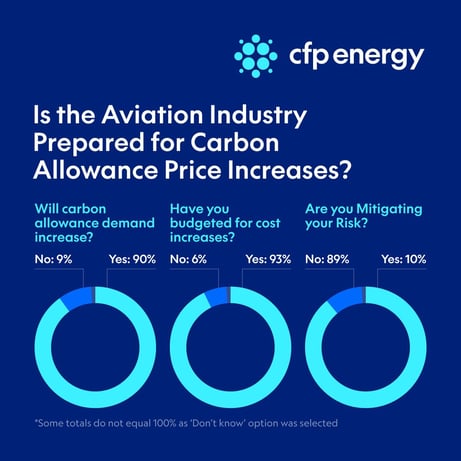
(For more insights on the aviation industry and it's carbon compliance positioning, access our full industry report featuring data gathered from airline operators across Europe, here)
Airlines that treat carbon allowances as a strategic input, integrated into fuel procurement, fleet planning and pricing strategies, will be better positioned to manage margin pressure and regulatory risk.
Those that fail to adapt face structurally higher costs, greater earnings volatility and an erosion of competitive advantage in an increasingly carbon-constrained operating environment.
About the author: CFP Energy
CFP Energy is a leading provider of energy transition services, working with large corporations across Europe and beyond. Our team provides access to renewable and transition fuels, carbon compliance services and long-term risk management solutions.
Related Articles



Share this article