

What does this turbulent history mean for your climate strategy, today?
The voluntary carbon market didn't arrive fully formed. It was built, sometimes carefully and sometimes chaotically, over three decades of trial, controversy, and hard-won reform.
Understanding that history isn't just interesting background.
It's the key to navigating the market wisely.
 The Early Years: A Market Invents Itself
(1989–2000)
The concept of carbon offsetting predates the internet. In 1989, Applied Energy Services, a US power company, partnered with the World Resources Institute to plant trees in Guatemala to offset emissions from a new coal plant in Connecticut.
It was largely symbolic, and not particularly rigorous, but it planted an idea.
Throughout the 1990s, a loose community of environmentalists, academics, and forward-thinking businesses began experimenting with the concept.
There were no standards, no registries, no third-party verification. Credits were largely self-reported.
Buyers were mainly motivated by genuine environmental concern rather than regulatory pressure, which is how the "voluntary" name stuck.
This was a market for those choosing to act, not those required to. And then, in 1997, the Kyoto Protocol changed the landscape.
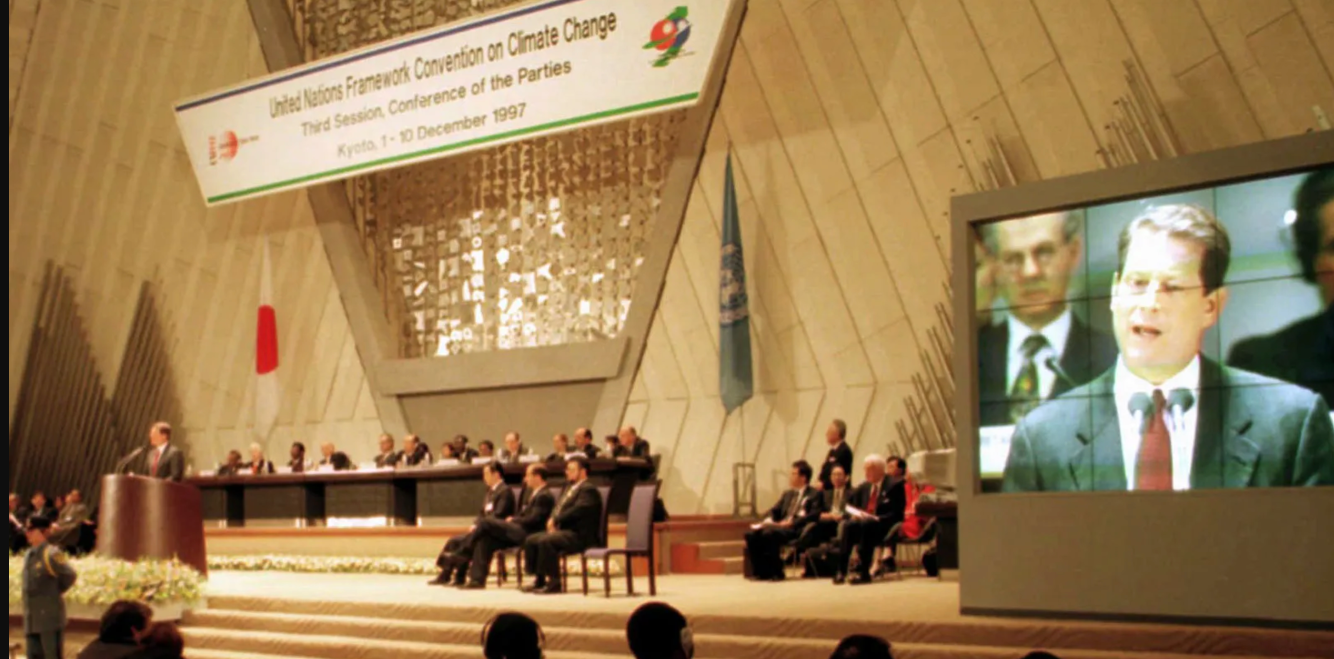 (Al Gore giving a speech during the UN convention on climate change in Kyoto)
Alongside binding emissions targets for developed countries, it created the Clean Development Mechanism (CDM), a compliance tool that allowed wealthier nations to fund emissions reduction projects in developing countries and earn credits in return.
It was the first large-scale attempt to put a functioning market infrastructure around carbon. The voluntary market watched closely and began borrowing the logic, if not yet the rigour...
Building the Architecture: Standards and Registries Emerge
(2000–2012)
By the early 2000s, it was clear the market needed infrastructure.
Without common standards, "carbon credits" meant almost anything: a tonne saved here might not equal a tonne saved there. Credibility was thin.
Several institutions rose to address this:
The Gold Standard (2003) was founded by WWF and other NGOs with a deliberate focus on sustainable development co-benefits alongside carbon reduction. It brought a higher bar to project quality.
The Verified Carbon Standard (now known as Verra's VCS Programme, 2005) became the market's largest registry, developing detailed methodologies for everything from avoided deforestation to industrial gas destruction.
The Chicago Climate Exchange (CCX), which ran from 2003 to 2010, was the world's first greenhouse gas emission reduction and trading system. Though it ultimately closed, it proved the market mechanics could function.
These years saw genuine growth. Credits flowed. Corporations began buying offsets to claim carbon neutrality. The rainforest entered the conversation as a potential offset source through the REDD+ framework (Reducing Emissions from Deforestation and Forest Degradation). The market had real ambition.
But the foundations were not yet solid.
The First Crisis: Credibility Collapses
(2008–2016)
A series of uncomfortable revelations began to erode confidence. Industrial gas credits, particularly HFC-23, a potent refrigerant destroyed in exchange for large numbers of carbon credits, turned out to create perverse incentives: factories were reportedly producing more of the gas in order to destroy it for profit.
The practice was eventually banned from most standards.
Renewable energy credits in the developing world faced questions about additionality, the critical test of whether a project genuinely caused emissions reductions that wouldn't have happened anyway.
Wind and solar projects in countries where those technologies were already commercially viable were generating credits for business-as-usual activity.
Then came the financial crisis of 2008, which dampened corporate sustainability ambitions broadly. The voluntary carbon market contracted. Many projects stalled. Prices fell.
The years from roughly 2008 to 2016 were a difficult period of low confidence and low prices. But they were also years of quiet reform. Standards bodies tightened methodologies.
The concept of permanence, ensuring that stored carbon stays stored, became more central to project evaluation.
The market emerged smaller but more serious.
The Boom and the Backlash
(2020–2023)
The net-zero era arrived quickly.
As corporations raced to make climate commitments in the wake of the Paris Agreement and mounting investor pressure, demand for carbon credits surged. Between 2020 and 2021, the voluntary carbon market more than doubled in value. It was projected to grow fifteenfold by 2030.
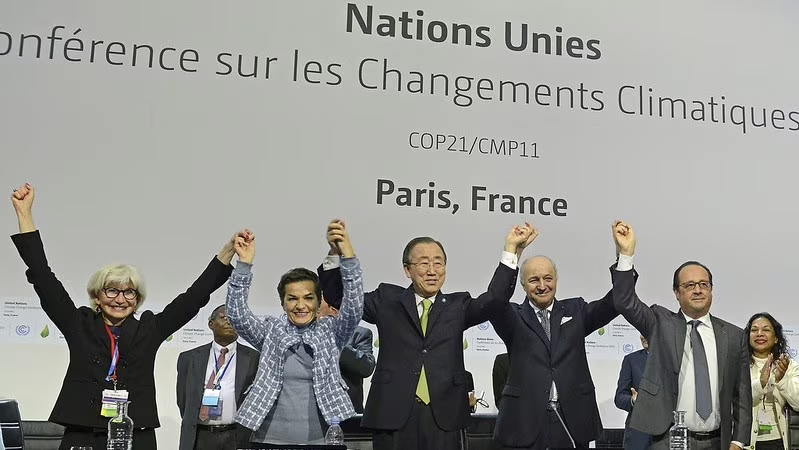 (Former UN Climate Change head Christiana Figueres celebrates the signing of the Paris Agreement on 12 December 2015 with Cop21 president Laurent Fabius and former French President Francois Hollande)
With that boom came scrutiny, and some of it was damaging.
In January 2023, a major investigation by The Guardian, Die Zeit, and SourceMaterial found that a large proportion of Verra's REDD+ rainforest protection credits, some studies suggested over 90%, may not have represented real carbon reductions.
The analysis challenged the baseline methodologies used to estimate what deforestation would have happened without the project in place.
Verra disputed the findings vigorously, and the full picture remains contested.
But the reputational impact was immediate. Several major corporations quietly withdrew claims built on rainforest credits. Verra's CEO resigned.
The market faced its most significant credibility challenge since HFC-23.
Greenwashing concerns, already simmering, came to a boil. Regulators and NGOs began scrutinising net-zero claims more closely.
The word "offset" became almost politically toxic in some quarters.
Reform and Maturation: The Market Rebuilds
(2023–Present)
Rather than collapse, the market responded with a wave of reform. Several developments are reshaping it:
The Integrity Council for the Voluntary Carbon Market (ICVCM) published its Core Carbon Principles (CCP) in 2023, a set of rigorous, science-based standards that credits must meet to carry an "IC-VCM approved, CCP” label. This is the most significant quality framework the market has ever had.
The Voluntary Carbon Markets Integrity Initiative (VCMI) released guidance for corporate buyers, setting out what constitutes a credible claim when using carbon credits, moving the market away from blanket "carbon neutral" language toward more precise, defensible statements.
Independent ratings agencies have also become a critical layer of market infrastructure. Firms like BeZero Carbon, Sylvera, and Calyx Global now provide credit-level ratings, assessing individual projects against criteria like additionality, permanence, and methodology robustness, independently of the standards bodies that issued them.
This separation of roles matters: a credit can carry a Verra or Gold Standard certification and still receive a poor rating if an agency's analysis finds the underlying assumptions weak.
For buyers, ratings agencies provide the kind of granular, comparable due diligence that the market previously lacked entirely.
The CDM itself is being wound down.
The mechanism that defined compliance carbon markets for two decades is in the final stages of closure, with all remaining transactions set to be discontinued by the end of 2026.
Its successor, the Paris Agreement Crediting Mechanism (PACM) under Article 6.4, is designed to address many of the CDM's shortcomings with stricter methodologies, mandatory corresponding adjustments to prevent double-counting, and stronger governance.
It is, in many ways, the institutional acknowledgement that the old architecture was not fit for purpose. For the voluntary market, which spent years learning from and reacting to the CDM's failures, its closure marks a genuine turning point.
Methodologies are improving. Remote sensing, satellite monitoring, and AI-assisted measurement are making it harder for weak projects to hide behind uncertain baselines.
Price differentiation is sharpening: high-quality credits from rigorous projects are increasingly valued above generic offsets.
The market is smaller and more cautious than it was at its 2022 peak. But the infrastructure being built now is more durable than anything that existed before.
What This Means for You...
The history of the VCM is not a cautionary tale about carbon markets, it's a story about a market finding its footing.
Every major financial and commodities market has gone through analogous periods of early excess, scandal, and reform. What matters is where it ends up.
For buyers today, the lessons are practical:
Quality is not uniform
A tonne is not a tonne. The difference between a credit that represents a genuine, additional, permanent reduction and one that doesn't can be enormous, and the reputational risk of getting it wrong is real.
Claims must match the evidence
The era of broad "carbon neutral" declarations built on cheap offsets is over. Precise, defensible claims supported by high-quality credits are the standard regulators and stakeholders increasingly expect.
Due diligence is an investment, not a cost
The companies that weathered the 2023 credibility crisis were those that had done the work on project quality before buying. Knowing what you own, and why it's credible, matters.
The voluntary carbon market is not perfect. But it is maturing.
And for organisations serious about their climate commitments, that makes it more important to engage with carefully, not to walk away from.
Want to see what CFP Energy has to say on the matter? Here's our team...
About the author: Jaclyn Foss
Jaclyn Foss is a leading expert on environmental regulations covering the aviation sector, with the rollout and implementation of CORSIA, a key focus. Jaclyn works closely with large airline operators, providing strategy, compliance support and risk management solutions.
Related Articles

.jpg?width=110&height=82&name=luka-slapnicar-yqeXLR81Uj0-unsplash%20(1).jpg)

Share this article