
.jpg?width=1920&name=luka-slapnicar-yqeXLR81Uj0-unsplash%20(1).jpg)
Yesterday, the Science Based Targets initiative released Corporate Net-Zero Standard Version 2.0, its first major overhaul since 2021.
For corporate sustainability and procurement teams, one line in the new standard deserves particular attention: SAF certificates issued under a book-and-claim model are now an explicitly recognised mechanism for addressing Scope 3 emissions.
Formally. In writing. In the world's most widely used corporate net-zero framework.
Which raises an obvious question. If your organisation has not yet engaged with SAF certificates, you might be wondering what, exactly, you have just been handed permission to use.
Axel Vanmeulder, CFP Energy's SAFc lead, puts it plainly:
"We have been having this conversation with procurement teams for two years, SAFc is a credible mechanism, the certificates are verified, and the emissions reductions are real. The SBTi endorsement removes the last reason to wait. If aviation sits in your Scope 3 and you do not have a SAFc strategy, now is the time to build one."
Why the SBTi Endorsement Matters
Until yesterday, corporates using SAFc for Scope 3 business travel emissions were operating in a grey zone.
The logic was sound, the certificates were legitimate, but explicit SBTi recognition was absent. That created hesitation, particularly in organisations where the sustainability team needs to demonstrate that a procurement decision will hold up to scrutiny.
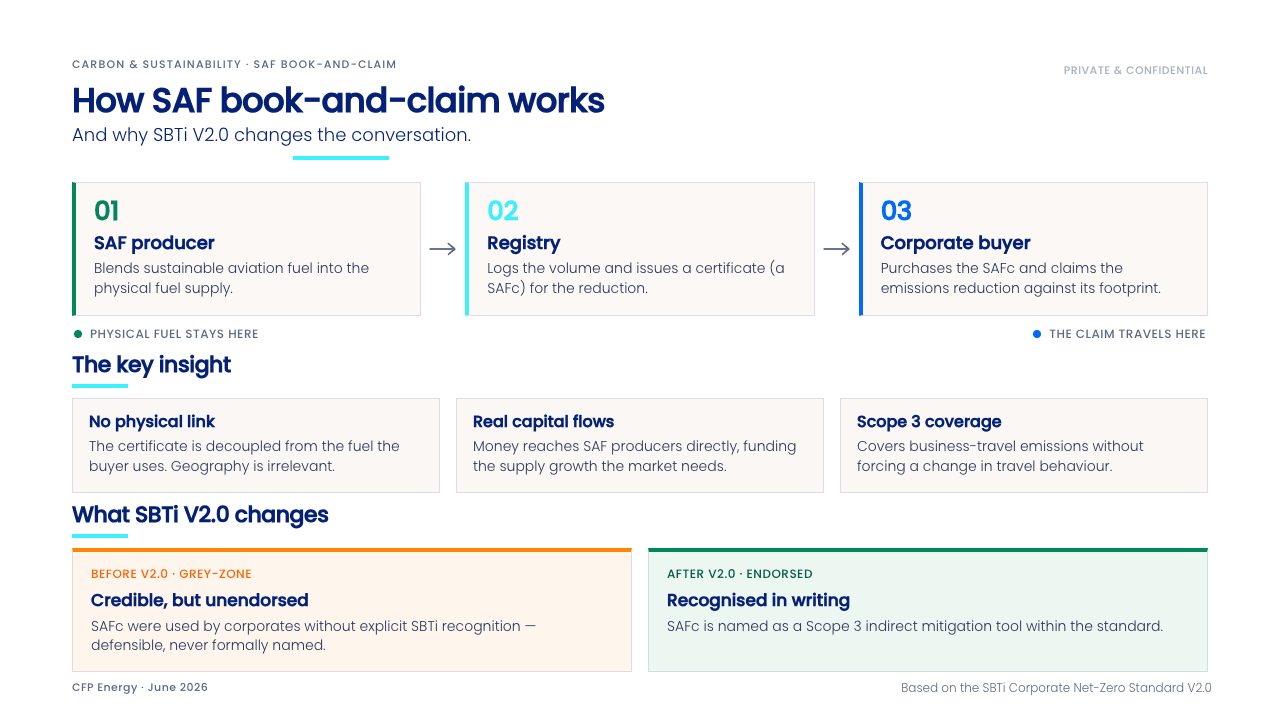
V2.0 resolves that. Environmental Attribute Certificates, including SAF book-and-claim certificates, are now a defined Scope 3 indirect mitigation tool within the standard, specifically for emissions that cannot yet be directly addressed due to infrastructure or supply constraints. The standard names business travel via SAF certificates as a use case.
Two qualifiers worth being clear about. First, this is positioned as a time-limited mechanism, a bridge while physical SAF supply scales, not a permanent accounting workaround.
Second, quality matters: V2.0's integrity requirements are closely aligned with the ICVCM's Core Carbon Principles, meaning the certificate needs to be backed by verified, additional, traceable emissions reductions. Registry and chain-of-custody rigour are not optional.
Both of those qualifiers are reasonable. Neither diminishes the practical significance of the endorsement.
Where Carbon Credits Fit
SAFc is not the only mechanism V2.0 formalises. The standard also introduces an Ongoing Emissions Responsibility framework, giving high-quality carbon credits a defined role for the first time, not as a substitute for Scope 3 reductions, but as a recognised complement.
Companies can now achieve formal "Recognised" or "Leadership" status for addressing residual ongoing emissions through carbon credit procurement, subject to quality thresholds.
The two mechanisms serve different purposes.
SAFc is a Scope 3 tool, it addresses the emissions associated with a specific activity in your value chain.
Carbon credits under the OER framework sit outside the target structure and address what remains after reductions have been made. Used together, they form a credible, layered approach to the emissions that are hardest to eliminate quickly.
What Is SAF?
Sustainable Aviation Fuel is a drop-in alternative to conventional jet fuel, produced from feedstocks ranging from used cooking oil and agricultural residues to municipal solid waste.
It can reduce lifecycle greenhouse gas emissions by up to 80% compared to the fossil fuel it replaces, and it works in existing aircraft engines without modification, no new infrastructure required.
The catch, and it is a meaningful one, is supply.
SAF currently represents well under 1% of total aviation fuel consumption globally. Production is growing, but the gap between where supply is now and where demand needs to be to hit industry decarbonisation targets is substantial.
For most corporate buyers, physically purchasing SAF and ensuring it ends up in the fuel tank of the plane their employees are flying on is not a realistic near-term option.
This is where book-and-claim comes in.
How Book-and-Claim Works
Book-and-claim decouples the environmental benefit of SAF from its physical delivery. A producer blends SAF into the aviation fuel supply at a particular airport or hub.
That volume and the associated emissions reduction is logged on a registry and issued as a certificate. A corporate buyer anywhere in the world can then purchase that certificate, "claiming" the emissions reduction for their own reporting purposes, regardless of which aircraft physically used the fuel.
It works on the same principle as renewable energy certificates in the power sector. You do not need a wire running directly from a wind farm to your office to credibly claim renewable electricity. The certificate is the mechanism that makes geography irrelevant and participation accessible.
For a procurement team trying to address employee air travel in their Scope 3 inventory, SAF certificates are currently the most credible, scalable tool available. They are verifiable, they direct real capital toward SAF producers, and they accelerate the supply build that will eventually make physical SAF more widely accessible.
The Practical Upshot
If your organisation has SBTi targets and business travel sits in your Scope 3 inventory, the case for engaging with SAF certificates is now clearer than it has ever been.
The framework is in place. The certificates exist. The supply is constrained but growing -- and corporate procurement is part of what drives that growth.
The transition timeline gives you room to move thoughtfully: Version 1.3.1 remains valid for new target submissions through 2026, with V2.0 becoming mandatory for all new submissions from February 2028.
But waiting for the deadline to figure out your approach is, as always, the more expensive option.
If you want to understand how SAFc fits into your current decarbonisation programme, or how to evaluate certificate quality before you commit, we are happy to walk through it.
Contact our team, here.
About the author: CFP Energy
CFP Energy is a leading provider of energy transition services, working with large corporations across Europe and beyond. Our team provides access to renewable and transition fuels, carbon compliance services and long-term risk management solutions.
Related Articles



Share this article