

The challenge to decarbonise the aviation industry is no longer defined by ambition but by execution.
European airlines are operating in a landscape where carbon compliance costs are rising, fuel price volatility remains structurally high and long-term abatement options such as Sustainable Aviation Fuel (SAF) are still scaling.
At the same time, regulatory clarity is improving and the carbon market toolkit available to aviation professionals is more developed than at any point in the past decade.
The most resilient airlines are approaching decarbonisation not as a single obligation, but as a portfolio of risks and opportunities.
EU ETS, CORSIA, SAF credits, voluntary carbon markets and jet fuel hedging each address different dimensions of the challenge.
When used together, they can improve cost visibility, support compliance and create flexibility during the transition.
For immediate support on carbon compliance or sustainable fuels, our award-winning team can provide pricing and bespoke long-term strategy options for your organisation, here.
EU ETS: from compliance obligation to cost management strategy
Aviation has been covered by the EU Emissions Trading Scheme since 2012, applying to CO₂ emissions from flights within the European Economic Area and to Switzerland.
Following Brexit, flight departures from the UK are covered by the UK ETS, while flights from the EEA to the UK remain under the EU ETS.
The impact of the scheme on aviation is now increasing rapidly. Under the Fit for 55 reforms, free allocation of aviation allowances is being phased out between 2024 and 2026. Previously, around 82 percent of aviation allowances were allocated for free.
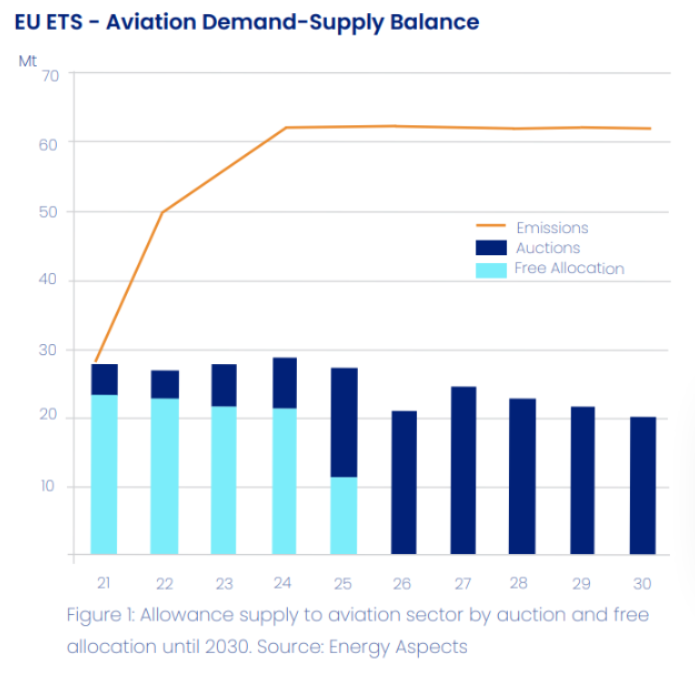
From 2026 onwards, all aviation allowances will be auctioned or sourced via the secondary market.
At the same time, the overall ETS cap is tightening. The linear reduction factor has been increased to 4.3 percent per year for 2024 to 2027 and 4.4 percent for 2028 to 2030, reducing allowance supply across all sectors.
EUA prices have reflected this tightening, rising from around €30 per tonne in 2021 to peaks above €100 per tonne in 2023, with forecasts pointing to sustained upward pressure later this decade
For airlines, this means ETS is now a material operating cost rather than a marginal compliance item.
The difficulty in dealing with these changes is exemplified by comments made by Ryanair CEO Michael O’Leary:
“The [aviation] emissions trading system is a grievous tax on efficiency in Europe. We exempt all the non-Europeans... the long-haul airlines arriving in Europe, who account for 53% of European aviation CO2 emissions, are exempt from their fair share of environmental taxes.” Montel
The most effective response to EU ETS exposure is to manage carbon allowances in the same way airlines already manage fuel. That means forecasting emissions accurately, planning procurement in advance and avoiding concentration of purchases around compliance deadlines.
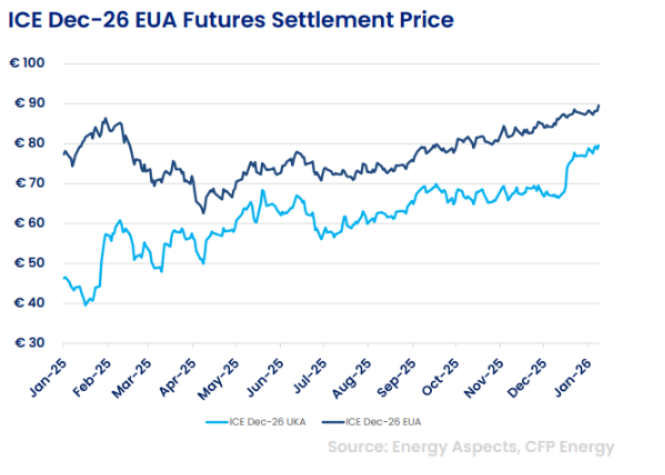
Rather than relying solely on spot buying, many airlines are spreading purchases over time or using forward structures to smooth price risk.
This approach does not remove cost, but it significantly improves visibility and reduces exposure to short-term market spikes driven by weather, energy prices or financial positioning.
Aviation operators increasingly need a tailored carbon risk management strategy that takes account of emissions forecasts, budget constraints, risk appetite and views on price direction.
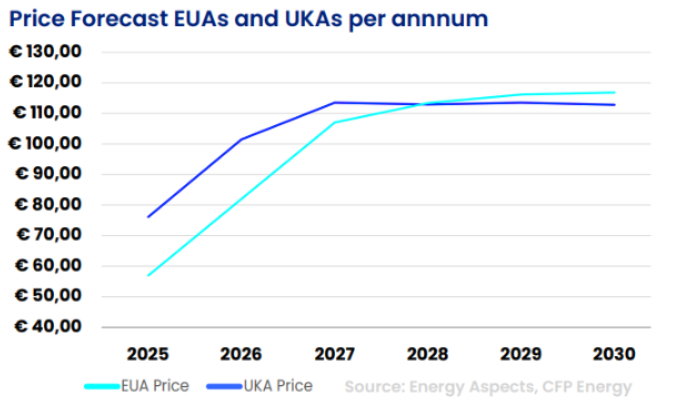
Embedding ETS management within treasury or fuel risk functions reflects how central carbon has become to commercial decision-making.
To access market-beating prices for ETS compliance, contact our team, here.
CORSIA: building global carbon capability
The Carbon Offsetting and Reduction Scheme for International Aviation (CORSIA) applies to emissions growth from international flights above 2019 levels.
Countries participated voluntarily during the pilot phase from 2021 to 2023 and Phase 1 from 2024 to 2026.
From Phase 2, covering 2027 to 2030, offsetting becomes mandatory for most international aviation, with exemptions for small island states and low-income countries.
At present, the EU has extended the “stop-the-clock” mechanism, meaning international flights remain exempt from EU ETS until the end of 2026.
The European Commission will assess CORSIA’s effectiveness by July 2026 and may propose including flights to and from countries outside the EU in the EU ETS if the scheme is judged insufficient.
In such a case, airlines would be able to credit CORSIA obligations against EU ETS requirements.
This evolving interaction between CORSIA and regional ETS schemes creates uncertainty, particularly for airlines operating global networks.
Rather than viewing CORSIA as a minimal obligation, many airlines are using it as a foundation for building internal carbon market capability.
Early engagement allows operators to understand credit quality, develop procurement governance and gain experience in managing offset portfolios before participation becomes mandatory at scale.
For operators, credit selection is a central pillar of a long-term strategy.
Focusing on eligible, high-quality credits aligned with CORSIA principles reduces reputational risk and positions airlines well as scrutiny increases.
For immediate CORSIA price data, contact our team, here.
Forward planning also helps avoid congestion and price pressure as demand rises ahead of Phase 2.
By treating CORSIA as part of a broader carbon strategy rather than a standalone requirement, airlines are better prepared for potential convergence between global and regional regimes.
Jet fuel hedging and carbon: aligning two critical risks
Jet fuel remains aviation’s largest and most volatile cost.
Fuel price shocks are often linked to the same geopolitical and energy market dynamics that influence carbon prices. Longer routing due to airspace restrictions increases fuel burn and emissions simultaneously, amplifying exposure.
Leading airlines increasingly manage fuel and carbon together.
Integrated forecasting helps operators understand how operational changes affect both fuel and allowance requirements.
Structured fuel hedging stabilises cash flow, while planned carbon procurement improves cost visibility.
It means that the lesson from fuel markets is well established.
Hedging does not eliminate cost, but it reduces uncertainty. Applying the same discipline to carbon markets supports better commercial decision-making and protects investment capacity during the transition.
We can help you secure the best jet fuel costs, here.
SAF credits: supporting long-term decarbonisation while managing near-term constraints
Sustainable Aviation Fuel is widely recognised as aviation’s most important long-term decarbonisation lever.
Lifecycle emissions reductions of up to 80 percent are achievable depending on feedstock and production pathway. However, supply remains limited.
SAF accounted for well under 1% of global aviation fuel use in 2023, according to the International Energy Agency.
Costs remain significantly higher than conventional jet fuel, often two to five times higher.
At the same time, regulatory pressure is increasing.
Under ReFuelEU Aviation, SAF blending obligations rise steadily through the 2030s, increasing demand before supply has fully scaled.
Given these constraints, airlines are increasingly adopting a phased SAF strategy.
Rather than relying solely on physical fuel, SAF credits and book-and-claim mechanisms allow airlines to support market development and meet obligations where supply is not yet available at specific airports.
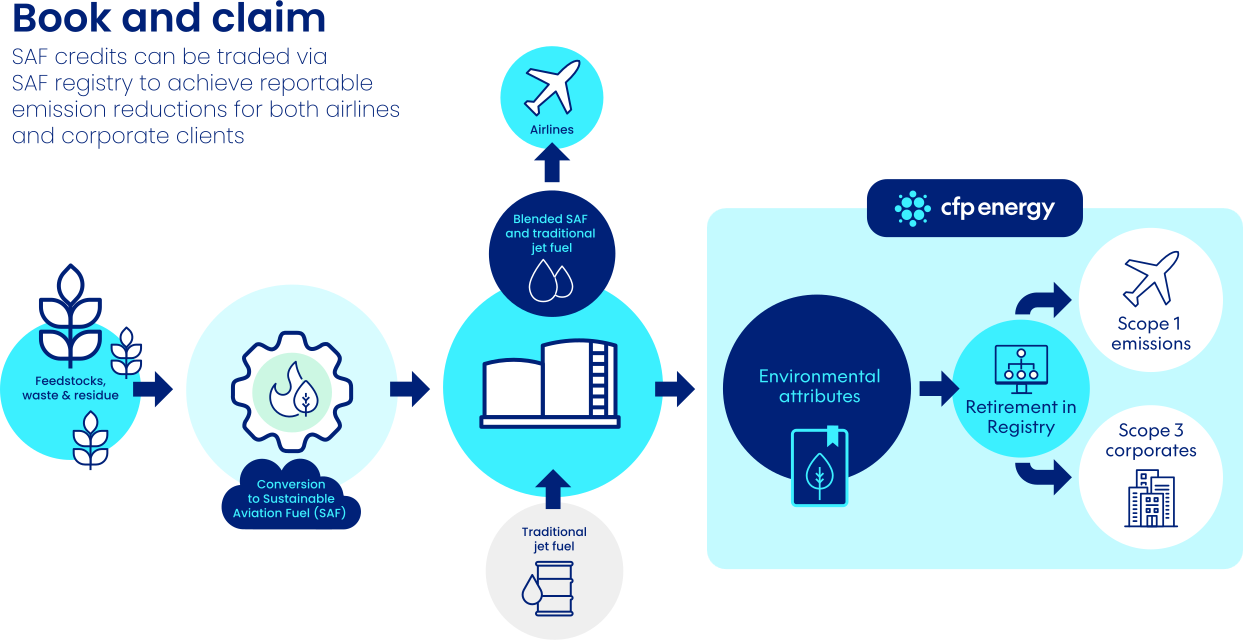
Strategically, SAF should be viewed as a structural hedge against future carbon tightening.
Lower lifecycle emissions reduce exposure to ETS costs and strengthen resilience as allowance prices rise.
Long-term offtake agreements and early engagement with SAF credit markets can also improve access and price visibility as competition for supply increases.
Used in this way, SAF becomes both a decarbonisation tool and a risk management instrument.
Voluntary carbon markets: addressing residual emissions with integrity
Even with efficiency improvements and SAF uptake, aviation will continue to generate residual emissions for the foreseeable future.
Voluntary carbon markets have historically been approached cautiously due to concerns around quality and additionality, though this is changing.
Airlines face increasing expectations from corporate customers, investors and regulators to demonstrate credible interim action.
Voluntary carbon markets are maturing rapidly. Independent integrity initiatives, clearer methodologies and tighter eligibility criteria are improving confidence in high-quality credits.
For airlines, voluntary carbon works best when clearly positioned as a complement to compliance markets.
It is particularly effective for addressing residual emissions, supporting corporate travel programmes and bridging the gap while SAF and new technologies scale.
IATA estimates that carbon credits and removals will account for around 20% of cumulative emissions reductions required for aviation to reach net zero by 2050.
Used responsibly, voluntary carbon provides flexibility without undermining long-term decarbonisation objectives.
Once more, CFP Energy has a dedicated VCM team operating internationally, you can learn more about our offering and get immediate access to credits, here.
Jet fuel hedging and carbon: aligning two critical risks
Jet fuel remains aviation’s largest and most volatile cost.
Fuel price shocks are often linked to the same geopolitical and energy market dynamics that influence carbon prices. Longer routing due to airspace restrictions increases fuel burn and emissions simultaneously, amplifying exposure.
Leading airlines increasingly manage fuel and carbon together.
Integrated forecasting helps operators understand how operational changes affect both fuel and allowance requirements.
Structured fuel hedging stabilises cash flow, while planned carbon procurement improves cost visibility.
It means that the lesson from fuel markets is well established.
Hedging does not eliminate cost, but it reduces uncertainty. Applying the same discipline to carbon markets supports better commercial decision-making and protects investment capacity during the transition.
The most effective strategies recognise the complementary roles of ETS, CORSIA, SAF credits, voluntary carbon and fuel hedging.
Airlines that integrate these tools into a coherent framework gain flexibility, manage cost more effectively and demonstrate credible progress toward climate targets.
For aviation professionals, the strategic question is not whether to engage with carbon markets, but how to do so in a way that supports both decarbonisation and commercial success.
To understand the approach CFP Energy takes for airlines around the world, contact our award-winning team, here.
About the author: George Brown
George Brown is a researcher covering the energy and environmental industries, focusing on carbon regulations and the cutting-edge solutions being developed to decarbonise the aviation, shipping, manufacturing, construction and transport industries.
Related Articles
.jpg?width=110&height=82&name=luka-slapnicar-yqeXLR81Uj0-unsplash%20(1).jpg)


Share this article