

The New Carbon Market That Will Reshape Europe’s Transport, Buildings and Energy Systems
Europe is entering a new phase of its decarbonisation strategy.
With the launch of ETS2, a dedicated emissions trading system covering road transport and buildings, the EU is extending carbon pricing into the daily economy for the first time.
What began in 2005 as a compliance framework for power producers and heavy industry is now expanding toward the sectors most closely linked to household consumption, logistics networks and commercial operations.
This expansion is both economically significant and politically sensitive.
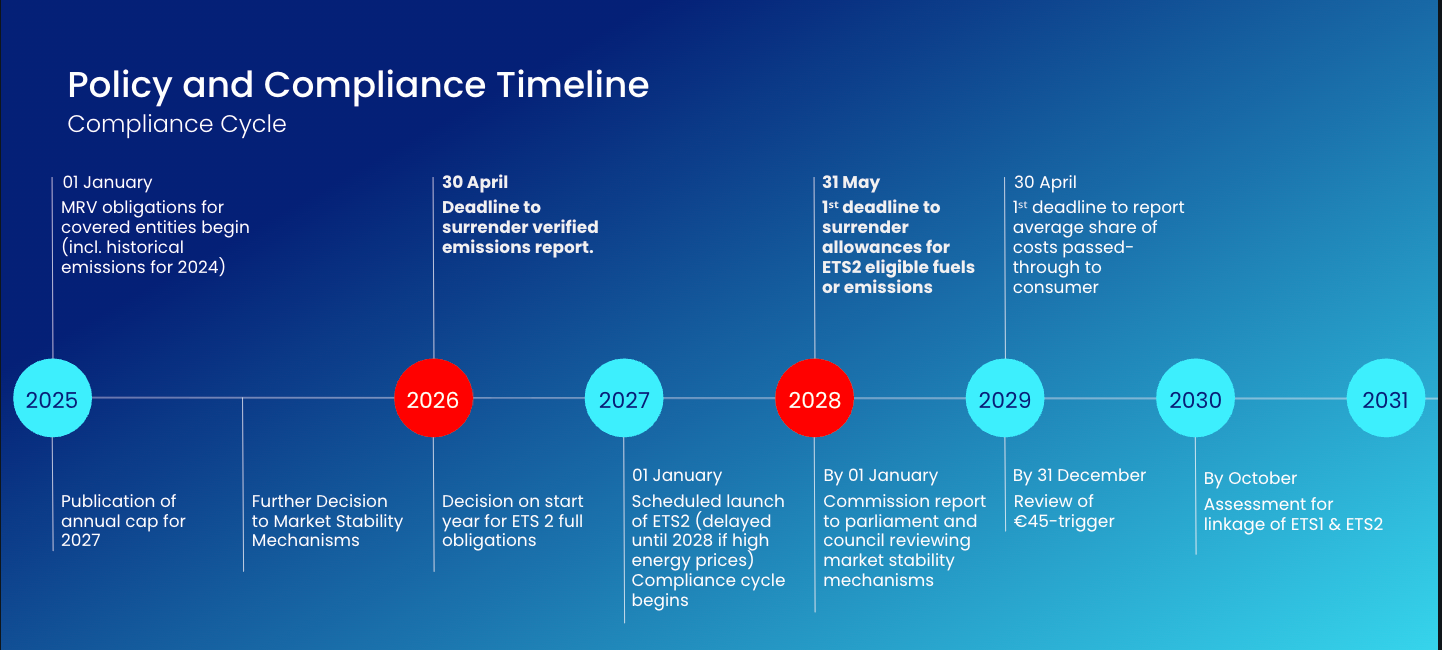
This point comes into sharp focus when considering the delay from 2027 to 2028, as internal pressures from industry giants may have driven the setback.
On the upside, ETS2 deepens the reach of carbon pricing, accelerates electrification across multiple sectors and forces companies to treat carbon not as an externality but as a variable cost driver shaping procurement, capital planning and operational strategy.
It will also drive much needed funding into decarbonisation technology and renewable infrastructure across the EU.
However, the minutia of the regulation is complex and it's impact differs from one industry to the next. It means that, for many, the impact of this new regulation may be completely unknown.
This article will explain the basics, but to prepare for ETS2 properly, you need expert help.
If you would like immediate support in planning for ETS2, you can connect with an award-winning carbon compliance team here, now.
ETS2 - A New Market with New Obligations
From 2028, suppliers of petrol, diesel, heating oil and natural gas will be required to purchase and surrender allowances matching the full CO₂ content of fuels sold for road transport and building use.
Monitoring obligations begin in 2025, creating a two-year window for companies to build reporting systems, emissions calculations and internal governance structures.
Once more, CFP Energy can help you build this process starting today.
- ETS2 is separate from the main EU ETS, with its own cap, auctions and registry.
- Early modelling suggests opening prices in the €45–€70/tCO₂e range.
- Volatility is expected in the early years as liquidity builds and electrification patterns accelerate.
Because fuel distributors will pass a significant share of compliance costs down the chain, ETS2 will impact nearly every sector of the economy, even those not directly regulated.
.png?width=2048&height=1152&name=CE%20Events%20(8).png)
We'll come on to this a little later.
Balancing Cost and Acceptance
Carbon pricing for transport and heating is politically sensitive.
To reduce the risk of social backlash, the EU has created an €86.7 billion Social Climate Fund to support vulnerable households, finance building renovation and accelerate low-carbon heating adoption.
Policymakers view the fund as essential to maintaining long-term acceptance of carbon pricing in consumer-facing sectors.
ETS2 Industry Impact Assessment
Below are clear, direct analyses of how ETS2 will reshape operations, cost structures and investment decisions across the key industries most exposed to the new carbon pricing regime.
Transport and Logistics
A carbon cost shock to Europe’s road-based economy...Road transport accounts for roughly a quarter of EU emissions, and ETS2 will immediately raise operating costs for road-dependent sectors.
Key impacts
- Fuel cost increase of 10–15 cents per litre in early years, depending on auction prices and supplier strategies.
- Freight and fleet operators face rising cost bases, influencing contract pricing and margins.
- Last-mile delivery becomes more expensive, with cost pass-through likely to reach retailers and consumers.
- Intensified pressure to electrify fleets, particularly vans, urban delivery vehicles and taxis.
- Companies with complex logistics will need carbon-cost clauses in transport contracts.
Strategic implications
Transport firms will need to adopt carbon hedging behaviours similar to those used in fuel markets, with price-risk models and structured procurement strategies.
.png?width=2048&height=1152&name=CE%20Events%20(7).png)
The competitive gap between electrified and fossil-fuel fleets will widen sharply from 2027 onwards.
The increased costs for fuel suppliers is likely to be passed on to consumers, and we have a dedicated feature covering this topic in more depth, here.
Real Estate, Construction and Heating
Heating fuels under direct carbon pricing for the first time...ETS2 will reshape the economics of buildings across residential, commercial and industrial segments.
Key impacts
- Significant cost increases for properties heated using oil or natural gas.
- A shift in building-level energy procurement strategies as carbon becomes a billable cost.
- Rising demand for heat pumps, district heating and insulation upgrades.
- Landlords, property managers and facility operators will face higher operating expenditure and potential tenant renegotiations.
Real estate portfolios with fossil-fuel heating systems will experience rising OPEX and potential valuation pressure. Construction firms must integrate ETS2 cost assumptions into project pricing, especially for gas-heated sites and construction machinery fuelled by diesel.
Retail, FMCG and Consumer-Facing Sectors
Thin-margin sectors face compounding cost inflation...Retailers and consumer-goods businesses rely heavily on road haulage and temperature-controlled logistics. Even small increases in fuel costs can compound sharply.
Key impacts
- Increased distribution costs for food, packaging, and consumer goods.
- Rising operational costs for large-footprint retail sites with gas heating.
- Inflationary pressure on home-delivery models as transport operators adjust pricing.
Retailers will need to model ETS2-driven inflation across SKUs, negotiate carbon-linked transport contracts and accelerate electrification of internal fleets (e.g., last-mile vans, warehouse vehicles, refrigeration units).
Manufacturing and Industrial Businesses
Indirect exposure through suppliers, logistics and heating...
Although most heavy industry remains under ETS1, manufacturers face substantial indirect ETS2 exposure.
Key impacts
- Higher inbound and outbound logistics costs.
- Increased heating costs for facilities and assembly sites.
- Cross-market volatility between ETS1 and ETS2 may influence procurement budgets and energy strategy.
Strategic implications
Manufacturers will need to integrate carbon pricing into supply-chain negotiations, including transport, warehousing and gas procurement. Plants located in regions with higher heating demand face greater ETS2-related inflation.
Agriculture and Food Supply Chains
Transport, refrigeration and input prices all exposed...
The agriculture and food sectors rely heavily on diesel-powered machinery, refrigerated transport and gas-intensive processing.
Key impacts
- Rising costs for farm-to-market logistics.
- Higher energy and heating costs for food processing plants.
- Potential push towards electrified or hybrid farming vehicles over the decade.
ETS2 will accelerate investment in energy-efficient cold-chain logistics, low-carbon farming machinery and on-site renewable generation.
Energy Suppliers and Utilities
A new compliance burden reshaping the fuel supply chain...
Fuel distributors are the entities directly obligated under ETS2.
Key impacts
- Mandatory purchase and surrender of ETS2 allowances.
- Creation of new treasury, data, and compliance functions.
- Increased operating costs likely to be passed through to customers.
Utilities and fuel suppliers must build carbon-market trading capabilities, implement granular volume forecasting and create robust compliance strategies. Forward procurement and hedging will be essential as volatility increases.
Power Markets and Electrification
ETS2 accelerates the shift to electricity—but strains the system. As carbon costs rise for fossil fuels, power demand will surge.
Key impacts
- Commission modelling suggests 10% higher electricity demand by 2030, driven by EV charging and heat pump deployment.
- Pressure on intraday trading, balancing markets and grid capacity.
- Greater demand for renewables, flexibility services, and energy-storage solutions.
Strategic implications
Electricity suppliers will play a central role in absorbing new demand and shaping consumer behaviour. Companies will need to plan EV charging infrastructure, low-carbon heating solutions, and flexible power procurement contracts.
From Compliance to Competitive Advantage
ETS2 forces companies to treat carbon like any other financial risk.Starting now, you and your business should be integrating this process.
- Mapping exposure across all operations and suppliers.
- Running price-risk scenarios up to €100/t.
- Integrating carbon into procurement, budgeting and logistics strategy.
- Developing electrification and efficiency roadmaps.
- Preparing for contract renegotiations with fuel-exposed suppliers.
ETS2 is not a 2027 issue, it is a 2025 planning priority.
Towards a Unified European Carbon Market
Although ETS2 is separate today, most analysts expect eventual convergence with the main ETS.
A unified carbon price across industry, buildings and transport would create a more coherent investment signal, shaping everything from the rollout of EV infrastructure to the economics of hydrogen, heat pumps and on-site renewables.
For corporates, this means carbon cannot be viewed as an environmental appendage. It becomes a structural component of cost, investment planning and competitive positioning.
Your Next Steps for ETS2
ETS2 is set to become one of the most transformational policy instruments in Europe’s climate architecture.
It will raise fuel prices, accelerate electrification, push buildings away from fossil heating and force companies to build carbon management into their strategic planning.
Across transport, retail, construction, energy, agriculture and manufacturing, the message is the same.
Carbon pricing is becoming a core business variable.
Companies that prepare early, through cost mapping, supplier engagement, data upgrades and electrification planning, will manage the transition.
Those that delay will face volatile costs, shrinking margins and mounting regulatory pressure.
Ensure you're ready for ETS2 by getting in touch with CFP Energy, here.
About the author: CFP Energy
CFP Energy is a leading provider of energy transition services, working with large corporations across Europe and beyond. Our team provides access to renewable and transition fuels, carbon compliance services and long-term risk management solutions.
Related Articles



Share this article